
 Posts
Posts


No BaNK DePoSiTS WiLL Be SPaReD FRoM CoNFiSCaTioN

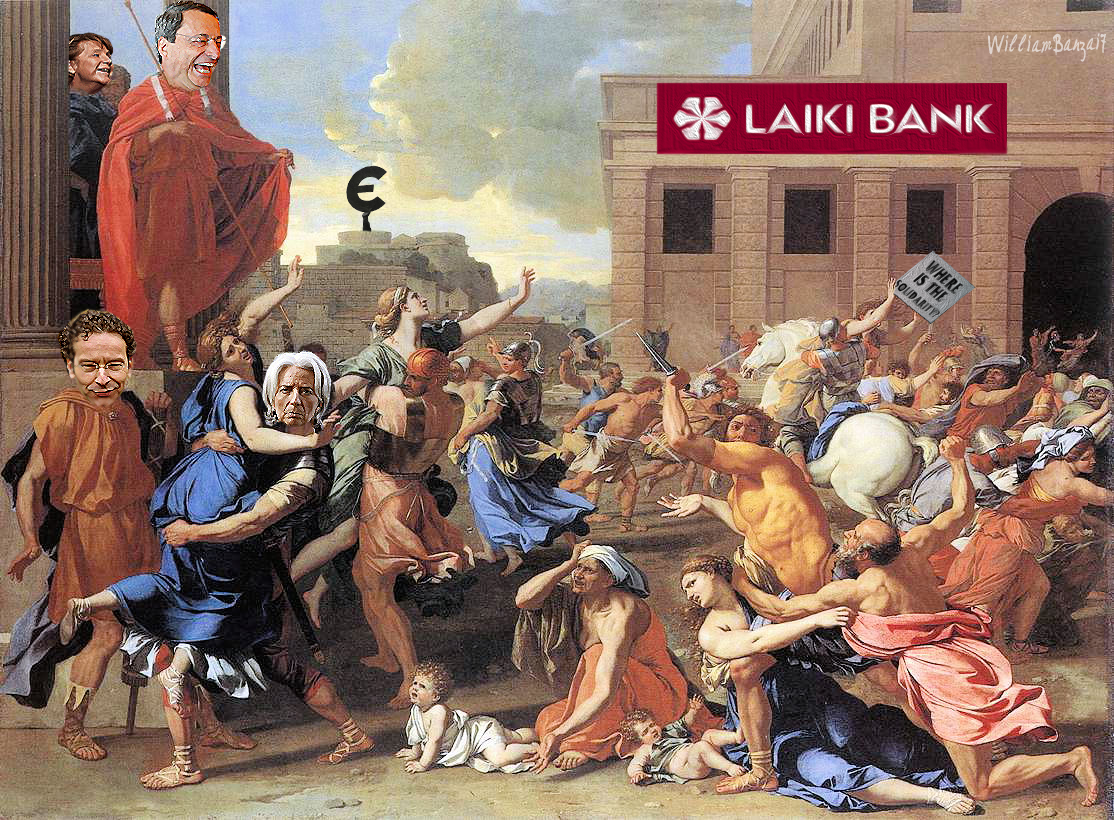
As alert Zero Hedge readers are aware, this week the EURO Politburo is busy debating the dodgy subject of deposit "bail-ins."
The following article very succinctly explains this odious mode of fractal fractional reserve end-game chicanery.
The author encourages all of you to share it with others.
WB7
NO BANK DEPOSITS WILL BE SPARED FROM CONFISCATION
By Matthias Chang Esq, futurefastforward.com (with author's permission)
I challenge anyone to prove me wrong that confiscation of bank deposits is legalized daylight robbery
Bank
depositors in the UK and USA may think that their bank deposits would
not be confiscated as they are insured and no government would dare
embark on such a drastic action to bail out insolvent banks.
Before
I explain why confiscation of bank deposits in the UK and US is a
certainty and absolutely legal, I need all readers of this article to do
the following:
Ask your local police, sheriffs, lawyers, judges the following questions:
1)
If I place my money with a lawyer as a stake-holder and he uses the
money without my consent, has the lawyer committed a crime?
2)
If I store a bushel of wheat or cotton in a warehouse and the owner of
the warehouse sold my wheat/cotton without my consent or authority, has
the warehouse owner committed a crime?
3)
If I place monies with my broker (stock or commodity) and the broker
uses my monies for other purposes and or contrary to my instructions,
has the broker committed a crime?
I am confident that the answer to the above questions is a Yes!
However,
for the purposes of this article, I would like to first highlight the
situation of the deposit / storage of wheat with a warehouse owner in
relation to the deposit of money / storage with a banker.
First,
you will notice that all wheat is the same i.e. the wheat in one bushel
is no different from the wheat in another bushel. Likewise with cotton,
it is indistinguishable. The deposit of a bushel of wheat with the
warehouse owner in law constitutes a bailment. Ownership of the bushel
of wheat remains with you and there is no transfer of ownership at all
to the warehouse owner.
And
as stated above, if the owner sells the bushel of wheat without your
consent or authority, he has committed a crime as well as having
committed a civil wrong (a tort) of conversion – converting your
property to his own use and he can be sued.
Let
me use another analogy. If a cashier in a supermarket removes $100 from
the till on Friday to have a frolic on Saturday, he has committed
theft, even though he may replace the $100 on Monday without the
knowledge of the owner / manager of the supermarket. The $100 the
cashier stole on Friday is also indistinguishable from the $100 he put
back in the till on Monday. In both situations – the wheat in the
warehouse and the $100 dollar bill in the till, which have been
unlawfully misappropriated would constitute a crime.
Keep this principle and issue at the back of your mind.
Now we shall proceed with the money that you have deposited with your banker.
I am sure that most of you have little or no knowledge about banking, specifically fractional reserve banking.
Since
you were a little kid, your parents have encouraged you to save some
money to instil in you the good habit of money management.
And
when you grew up and got married, you in turn instilled the same
discipline in your children. Your faith in the integrity of the bank is
almost absolute. Your money in the bank would earn an interest income.
And
when you want your money back, all you needed to do is to withdraw the
money together with the accumulated interest. Never for a moment did you
think that you had transferred ownership of your money to the bank.
Your belief was grounded in like manner as the owner of the bushel of
wheat stored in the warehouse.
However,
this belief is and has always been a lie. You were led to believe this
lie because of savvy advertisements by the banks and government
assurances that your money is safe and is protected by deposit
insurance.
But,
the insurance does not cover all the monies that you have deposited in
the bank, but to a limited amount e.g. $250,000 in the US by the Federal
Deposit Insurance Corporation (FDIC), Germany €100,000, UK £85,000 etc.
But,
unlike the owner of the bushel of wheat who has deposited the wheat
with the warehouse owner, your ownership of the monies that you have
deposited with the bank is transferred to the bank and all you have is
the right to demand its repayment. And, if the bank fails to repay your
monies (e.g. $100), your only remedy is to sue the bank and if the bank
is insolvent you get nothing.
You
may recover some of your money if your deposit is covered by an
insurance scheme as referred to earlier but in a fixed amount. But,
there is a catch here. Most insurance schemes whether backed by the
government or not do not have sufficient monies to cover all the
deposits in the banking system.
So, in the worst case scenario – a systemic collapse, there is no way for you to get your money back.
In
fact, and as illustrated in the Cyprus banking fiasco, the authorities
went to the extent of confiscating your deposits to pay the banks’
creditors. When that happened, ordinary citizens and financial analysts
cried out that such confiscation was daylight robbery. But, is it?
Surprise, surprise!
It
will come as a shock to all of you to know that such daylight robbery
is perfectly legal and this has been so for hundreds of years.
Let me explain.
The
reason is that unlike the owner of the bushel of wheat whose ownership
of the wheat WAS NEVER TRANSFERRED to the warehouse owner when the same
was deposited, the moment you deposited your money with the bank, the
ownership is transferred to the bank.
Your
status is that of A CREDITOR TO THE BANK and the BANK IS IN LAW A
DEBTOR to you. You are deemed to have “lent” your money to the bank for
the bank to apply to its banking business (even to gamble in the biggest
casino in the world – the global derivatives casino).
You
have become a creditor, AN UNSECURED CREDITOR. Therefore, by law, in
the insolvency of a bank, you as an unsecured creditor stand last in the
queue of creditors to be paid out of any funds and or assets which the
bank has to pay its creditors. The secured creditors are always first in
line to be paid. It is only after secured creditors have been paid and
there are still some funds left (usually, not much, more often zilch!)
that unsecured creditors are paid and the sums pro-rated among all the
unsecured creditors.
This is the truth, the whole truth and nothing but the truth.
The
law has been in existence for hundreds of years and was established in
England by the House of Lords in the case Foley v Hill in 1848.
When
a customer deposits money with his banker, the relationship that arises
is one of creditor and debtor, with the banker liable to repay the
money deposited when demanded by the customer. Once money has been paid to the banker, it belongs to the banker and he is free to use the money for his own purpose.
I will now quote the relevant portion of the judgment of #3b4d81;">the House of Lords handed down by Lord Cottenham, the Lord Chancellor. He stated thus:
“Money when paid into a bank, ceases altogether to be the money of the principal… it is then the money of the banker, who is bound to return an equivalent by paying a similar sum to that deposited with him when he is asked for it.
The
money paid into the banker’s, is money known by the principal to be
placed there for the purpose of being under the control of the banker; it
is then the banker’s money; he is known to deal with it as his own; he
makes what profit of it he can, which profit he retains himself,…
The
money placed in the custody of the banker is, to all intent and
purposes, the money of the banker, to do with it as he pleases; he
is guilty of no breach of trust in employing it; he is not answerable
TO THE PRINCIPAL IF HE PUTS IT INTO JEOPARDY, IF HE ENGAGES IN A
HAZARDOUS SPECULATION; he is not bound to keep it or deal with
it as the property of the principal, but he is of course answerable for
the amount, because he has contracted, having received that money, to
repay to the principal, when demanded, a sum equivalent to that paid
into his hands.” (quoted in UK Law Essays, #3b4d81;">Relationship Between A Banker And Customer,That Of A Creditor/Debtor, emphasis added,)
Holding that the relationship between a banker and his customer was one of debtor and creditor and not one of trusteeship, #3b4d81;">Lord Brougham said:
“This trade of a banker is to receive money, and use it as if it were his own, he becoming debtor to the person who has lent or deposited with
him the money to use as his own, and for which money he is accountable
as a debtor. I cannot at all confound the situation of a banker with
that of a trustee, and conclude that the banker is a debtor with a
fiduciary character.”
In plain simple English – bankers cannot be prosecuted for breach of trust, because
it owes no fiduciary duty to the depositor / customer, as he is deemed
to be using his own money to speculate etc. There is absolutely no
criminal liability.
The
trillion dollar question is, Why has no one in the Justice Department
or other government agencies mentioned this legal principle?
The
reason why no one dare speak this legal truth is because there would be
a run on the banks when all the Joe Six-Packs wise up to the fact that
their deposits with the bankers CONSTITUTE IN LAW A LOAN TO THE BANK and
the bank can do whatever it likes even to indulge in hazardous
speculation such as gambling in the global derivative casino.
The
Joe Six-Packs always consider the bank the creditor even when he
deposits money in the bank. No depositor ever considers himself as the
creditor!
Yes,
Eric Holder, the US Attorney-General is right when he said that bankers
cannot be prosecuted for the losses suffered by the bank. This is
because a banker cannot be prosecuted for losing his “own money” as
stated by the House of Lords. This is because when money is deposited
with the bank, that money belongs to the banker.
The reason that if a banker is prosecuted it would collapse the entire banking system is a big lie.
The
US Attorney-General could not and would not state the legal principle
because it would cause a run on the banks when people discover that
their monies are not safe with bankers as they can in law use the monies
deposited as their own even to speculate.
What is worrisome is that your right to be repaid arises only when you demand payment.
Obviously,
when you demand payment, the bank must pay you. But, if you demand
payment after the bank has collapsed and is insolvent, it is too late.
Your entitlement to be repaid is that of a lonely unsecured creditor and
only if there are funds left after liquidation to be paid out to all
the unsecured creditors and the remaining funds to be pro-rated. You
would be lucky to get ten cents on the dollar.
So,
when the Bank of England, the FED and the BIS issued the guidelines
which became the template for the Cyprus “bail-in” (which was endorsed
by the G-20 Cannes Summit in 2011), it was merely a circuitous way of
stating the legal position without arousing the wrath of the people, as
they well knew that if the truth was out, there would be a revolution
and blood on the streets. It is therefore not surprising that the global
central bankers came out with this nonsensical advisory:
“The
objective of an effective resolution regime is to make feasible the
resolution of financial institutions without severe systemic disruption
and without exposing taxpayers to losses, while protecting vital
economic functions through mechanisms which make it possible for
shareholders and unsecured and uninsured creditors to absorb losses in a
manner that respects the hierarchy of claims in liquidation.”(quoted
in #3b4d81;"> #3b4d81;">FSB Consultative Document: Effective Resolution of Systemically …)
This
is the kind of complex technical jargon used by bankers to confuse the
people, especially depositors and to cover up what I have stated in
plain and simple English in the foregoing paragraphs.
The key words of the BIS guideline are:
“without severe systemic disruptions” (i.e. bank runs),
“while protecting vital economic functions” (i.e. protecting vested interests – bankers),
“unsecured creditors” (i.e. your monies, you are the dummy),
“respects
the hierarchy of claims in liquidation” (i.e. you are last in the queue
to be paid, after all secured creditors have been paid).
This means all depositors are losers!
Please read this article carefully and spread it far and wide.
You will be doing a favour to all your fellow country men and women and more importantly, your family and relatives.


No comments:
Post a Comment