
 Posts
Posts


New cables 'expose' US govt lobbies worldwide for Monsanto, other GMO corps
Published time: May 14, 2013 20:38
Edited time: May 15, 2013 19:42
Edited time: May 15, 2013 19:42

Jane
Michalek (R) drinks soup during an eat-in protest in front of the U.S.
Food and Drug Administration's Center for Food Safety and Applied
Nutrition in College Park, Maryland April 8, 2013. (Reuters)
The August 2011 WikiLeaks revelations showed that American diplomats had requested funding to send lobbyists for the biotech industry to hold talks with politicians and agricultural officials in "target countries" in areas like Africa and Latin America, where genetically-modified crops were not yet a mainstay, as well as some European countries that have resisted the controversial agricultural practice.
After a concerted effort to "closely examine five years of State Department diplomatic cables from 2005 to 2009 to provide the first comprehensive analysis of the strategy, tactics and U.S. foreign policy objectives to foist pro-agricultural biotechnology policies worldwide," nonprofit consumer protection group Food & Water Watch published on Tuesday a report showing in plain detail the depth of the partnership between the federal government and a number of controversial biotech companies that have slowly but surely pushed their GMO products on a number of new countries in recent years.
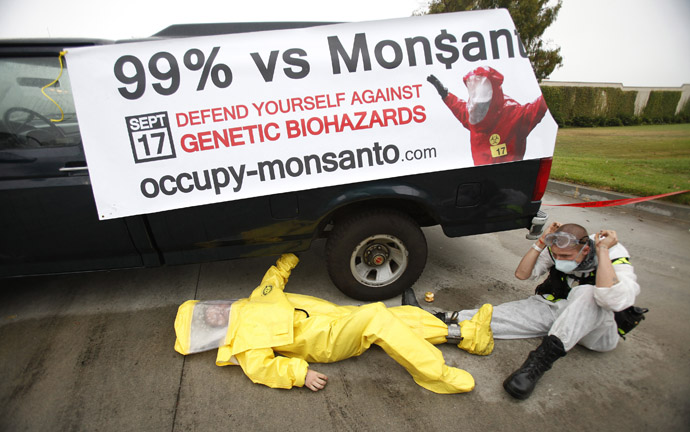
Protesters
against Genetically Modified Organisms (GMO) are chained to a vehicle
as they block a delivery entrance to a Monsanto seed distribution
facility in Oxnard, California September 12, 2012. (Reuters/Mario
Anzuoni)
“The US Department of State is selling seeds instead of democracy,” Food & Water Watch Executive Director Wenonah Hauter told reporters. “This report provides a chilling snapshot of how a handful of giant biotechnology companies are unduly influencing US foreign policy and undermining our diplomatic efforts to promote security, international development and transparency worldwide. This report is a call to action for Americans because public policy should not be for sale to the highest bidder.”
Food & Water Watch published their findings this week after combing through the roughly 260,000 State Department cables that the whistleblower website first began publishing in 2010, but notes that their statistics specifically come from memos not classified as 'secret' or higher.
For the most part, wrote the nonprofit, “The State Department strategy sought to foist pro-biotech policies on foreign governments” using a four-prong approach: promote biotech business interests; lobby foreign governments to weaken biotech rules; protect US biotech exports and press developing world to adopt biotech crops.
As the cables are analyzed, though, the efforts the State Department undertook to advocate for Monsanto demonstrate a willingness to put a US-based company’s profits about the interests and health of those residing in foreign nations.
In a cable sent from the Slovakian consulate in 2005, the State Department is told that the local post “will continue its efforts to dispel myths about GMOs and advocate on behalf of Monsanto.” In 2009, a cable out of Madrid, Spain announced that Monsanto had made “urgent requests” to fight off an anti-GMO opposition campaign that posed problems to the biotech industry. Other revelations show pro-GMO efforts waged by the US on behalf of the biotech industry in Hong Kong, the European Union, Egypt and elsewhere.
However, activists in the areas in question and elsewhere are taking note of Monsanto's dangerous and growing influence, with anti-Monsanto demonstrations planned in 36 cities on six continents for spring and summer 2013.
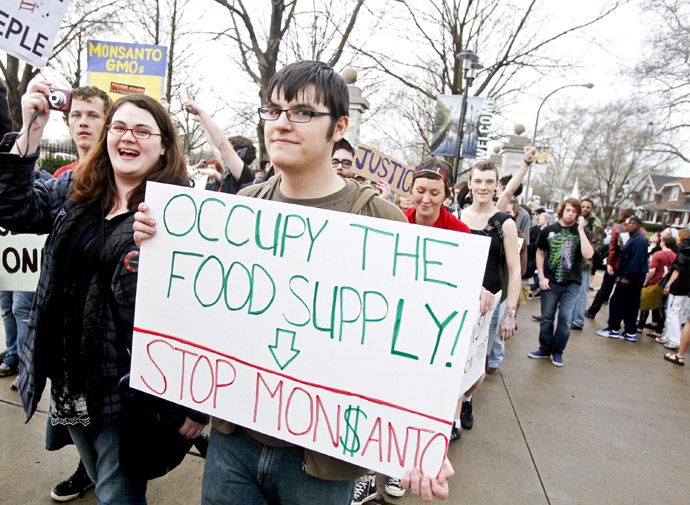
Members
of "Occupy" movements in the Midwest protest against Monsanto's
agricultural practices in front of the Missouri Botanical Garden during
the "Occupy the Midwest" regional conference in St. Louis, Missouri
March 16, 2012. (Reuters/Sarah Conard)
When Food & Water Watch scoured those cables, they concluded that the State Department was conducting off-the-radar negotiations that didn’t seem to advance democracy or American ideals — instead, rather, it found evidence of lobbying used to advance the agenda of thriving US companies that have already purchased the approval of much of Washington.
“It’s not surprising that Monsanto, DuPont, Syngenta, Bayer and Dow want to maintain and expand their control of the $15 billion global biotech seed market, but it’s appalling that the State Department is complicit in supporting their goals despite public and government opposition in several countries,” Ronnie Cummins, executive director of Organic Consumers Association, said in the press release accompanying the report. “American taxpayer’s money should not be spent advancing the goals of a few giant biotech companies.”
Of the 926 State Department cables analyzed by Food & Water Watch, the group found Monsanto appeared in more than 6 percent of the memos, shining light on how a federal agency “worked especially hard to promote the interests” of an outside company.
When reached for comment by Reuters, Monsanto spokesman Tom Helscher said, "We remain committed to sharing information so that individuals can better understand our business and our commitments to support farmers throughout the world as they work to meet the agriculture demands of our world's growing population.” The State Department did not immediately respond to requests for comment.
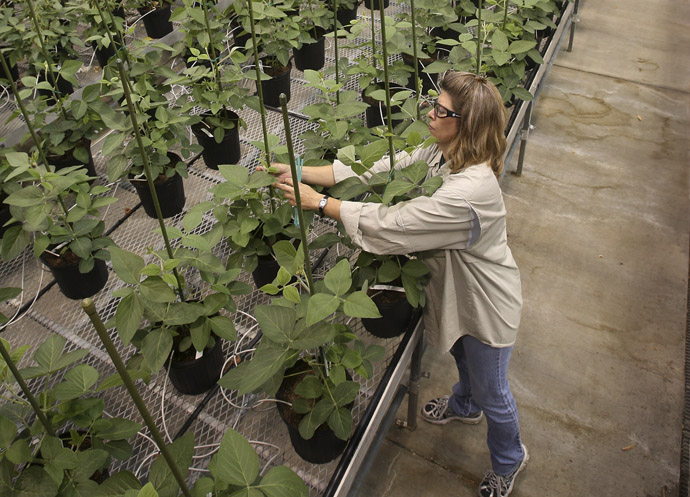
Nancy
Brumley, Monsanto Soybean Plant Specialist, ties up a stalk of soybean
in the soybean greenhouse at the Monsanto Research facility in
Chesterfield, Missouri October 9, 2009. (Reuters)
This week’s report comes just one day after Justice Thomas and the Supreme Court sided with Monsanto in reaching a decision in a landmark patent suit. In the case, the high court said that an Indiana farmer infringed on Monsanto’s patent rights by using specially-made seeds he obtained second-hand without signing a contract with the company. That ruling, however, came just days after the company was hit with comparably bad news: on Friday, the US Department of Agriculture ordered an extra round of tests for new GMO breeds being developed by Monsanto and Dow, putting on hold plans to release to the public laboratory-made crops that can withstand heavy dousing of dangerous pesticides. Both companies want to make available crops that are resistant to the chemicals 2,4-D and dicamba, a move that environmentalists fear will prompt farmers to use more of these toxins.
"The danger that 2,4-D and dicamba pose is a real threat to crops…nearly every food crop," Steve Smith, director of agriculture at Red Gold, told Reuters last year.


No comments:
Post a Comment