---BREAKAWAY CIVILIZATION ---ALTERNATIVE HISTORY---NEW BUSINESS MODELS--- ROCK & ROLL 'S STRANGE BEGINNINGS---SERIAL KILLERS---YEA AND THAT BAD WORD "CONSPIRACY"--- AMERICANS DON'T EXPLORE ANYTHING ANYMORE.WE JUST CONSUME AND DIE.---
Early on Halloween morning, members of Facebook's Computer Emergency
Response Team received an urgent e-mail from an FBI special agent who
regularly briefs them on security matters. The e-mail contained a
Facebook link to a PHP script that appeared to give anyone who knew its
location unfettered access to the site's front-end system. It also
referenced a suspicious IP address that suggested criminal hackers in
Beijing were involved.
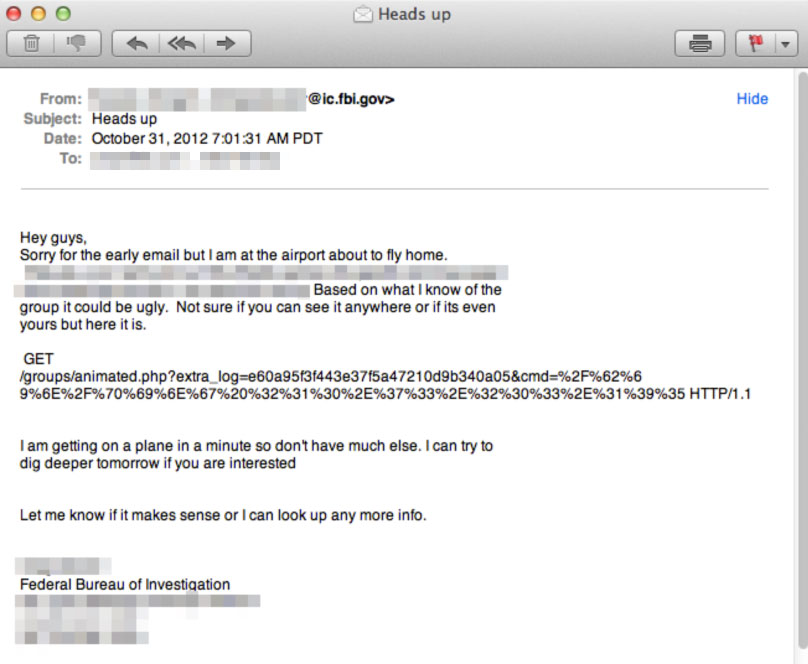
"Sorry for the early e-mail but I am at the airport about to fly
home," the e-mail started. It was 7:01am. "Based on what I know of the
group it could be ugly. Not sure if you can see it anywhere or if it's
even yours."
Enlarge/
The e-mail reporting a simulated hack into Facebook's network. It
touched off a major drill designed to test the company's ability to
respond to security crises.
Facebook
Facebook employees immediately dug into the mysterious code. What
they found only heightened suspicions that something was terribly wrong.
Facebook procedures require all code posted to the site to be handled
by two members of its development team, and yet this script somehow
evaded those measures. At 10:45am, the incident received a
classification known as "unbreak now," the Facebook equivalent of the US
military's emergency DEFCON 1 rating. At 11:04am, after identifying the
account used to publish the code, the team learned the engineer the
account belonged to knew nothing about the script. One minute later,
they issued a takedown to remove the code from their servers.
With the initial threat contained, members of various Facebook
security teams turned their attention to how it got there in the first
place. A snippet of an online chat captures some of the confusion and
panic:
Facebook Product Security: question now is where did this come from Facebook Security Infrastructure Menlo Park: what's [IP ADDRESS REDACTED] Facebook Security Infrastructure Menlo Park: registered to someone in beijing… Facebook Security Infrastructure London: yeah this is complete sketchtown Facebook Product Security: somethings fishy Facebook Site Integrity: which means that whoever discovered this is looking at our code
If the attackers were able to post code on Facebook's site, it stood
to reason, they probably still had that capability. Further, they may
have left multiple backdoors on the network to ensure they would still
have access even if any one of them was closed. More importantly, it
wasn't clear how the attackers posted the code in the first place.
During the next 24 hours, a couple dozen employees from eight internal
Facebook teams scoured server logs, the engineers' laptop, and other
crime-scene evidence until they had their answer: the engineer's fully
patched laptop had been targeted by a zero-day exploit that allowed
attackers to seize control of it.
This is only a test
The FBI e-mail, zero-day exploit, and backdoor code, it turns out,
were part of an elaborate drill Facebook executives devised to test the
company's defenses and incident responders. The goal: to create a
realistic security disaster to see how well employees fared at
unraveling and repelling it. While the attack was simulated, it
contained as many real elements as possible.
The engineer's computer was compromised using a real zero-day exploit
targeting an undisclosed piece of software. (Facebook promptly reported
it to the developer.) It allowed a "red team" composed of current and
former Facebook employees to access the company's code production
environment. (The affected software developer was notified before the
drill was disclosed to the rest of the Facebook employees). The PHP code
on the Facebook site contained a real backdoor. (It was neutralized by
adding comment characters in front of the operative functions.) Facebook
even recruited one of its former developers to work on the team to
maximize what could be done with the access. The FBI e-mail came at the
request of Facebook employees in an attempt to see how quickly and
effectively various employee teams could work together to discover and
solve the problems.
"Internet security is so flawed," Facebook Chief Security Officer Joe
Sullivan told Ars. "I hate to say it, but it seems everyone is in this
constant losing battle if you read the headlines. We don't want to be
part of those bad headlines."
The most recent dire security-related headlines came last week, when The New York Times reported China-based hackers had been rooting through the publisher's corporate network for four months. They installed 45 separate pieces of custom-developed malware, almost all of which remained undetected. The massive hack, the NYT
said, was pursued with the goal of identifying sources used to report a
story series related to the family of China’s prime minister. Among
other things, the attackers were able to retrieve password data for
every single NYT employee and access the personal computers of 53 workers, some of which were directly inside the publisher's newsroom.
As thorough and persistent as the NYT breach was, the style of attack is hardly new. In 2010, hackers penetrated the defenses of Google, Adobe Systems, and at least 32 other companies in the IT and pharmaceutical industries. Operation Aurora, as the hacking campaign came to be dubbed, exploited zero-day vulnerabilities in Microsoft's Internet Explorer browser
and possibly other widely used programs. Once attackers gained a
foothold on employee computers, they used that access to breach other,
more sensitive, parts of the companies' networks.
The hacks allowed the attackers to make off with valuable Google
intellectual property and information about dissidents who used the
company's services. It also helped coin the term "advanced persistent
threat," or APT, used to describe hacks that will last weeks or months
targeting a specific organization that possesses assets the attackers
covet. Since then, reports of APTs have become a regular occurrence. In
2011, for instance, attackers breached the servers of RSA
and stole information that could be used to compromise the security of
two-factor authentication tokens sold by the division of EMC. A few
months later, defense contractor Lockheed Martin said an attack on its
network was aided by the theft of the confidential RSA data relating to
its SecurID tokens, which some 40 million employees use to access
sensitive corporate and government computer systems.
"That was the inspiration around all this stuff," Facebook Security
Director Ryan "Magoo" McGeehan said of the company's drills. "You don't
want the first time you deal with that to be real. You want something
that you've done before in your back pocket."
Even after employees learned this particular hack was only for
practice—about a half hour after the pseudo backdoor was closed—they
still weren't told of the infection on the engineer's laptop or the
zero-day vulnerability that was used to foist the malware. They spent
the next 24 hours doing forensics on the computer and analyzing server
logs to unravel that mystery. "Operation Loopback," as the drill was
known internally, is notable for the pains it took to simulate a real
breach on Facebook's network.
"They're doing penetration testing as it's supposed to be done," said
Rob Havelt, director of penetration testing at security firm Trustwave. "A real pen test is supposed to have an end goal and model a threat. It's kind of cool to hear organizations do this." He said the use of zero-day attacks is rare but by no means unheard
of in "engagements," as specific drills are known in pen-testing
parlance. He recalled an engagement from a few years ago of a "huge
multinational company" that had its network and desktop computers fully
patched and configured in a way that made them hard to penetrate. As his
team probed the client's systems, members discovered 20
Internet-connected, high-definition surveillance cameras. Although the
default administrator passwords had been changed, the Trustwave team
soon discovered two undocumented backdoors built into the surveillance
cameras' authentication system.
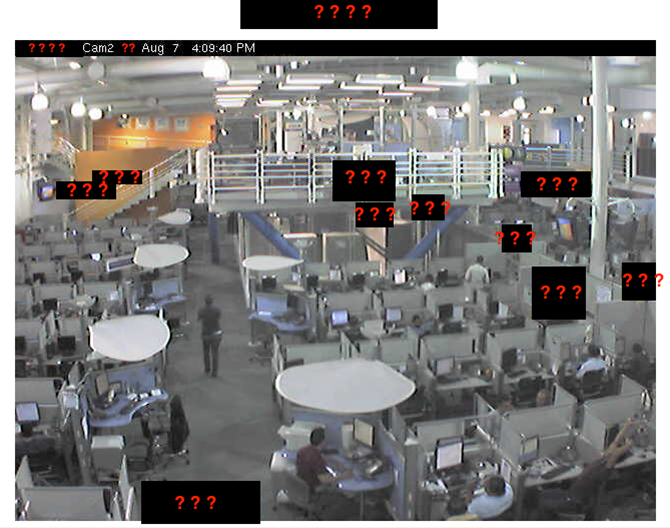
Enlarge/
An image retrieved from high-definition surveillance cameras used by a
large company. During a penetration test, Trustwave employees used them
to steal "tons" of login credentials.
Trustwave
Havelt's team exploited the backdoors to remotely take control of
the cameras. With the ability to view their output, change their
direction, and zoom in and out, the Trustwave employees trained them on
computer keyboards as employees in the unidentified company entered
passwords. With the help of the cameras' 10x zoom, the pen testers were
able to grab a "ton" of credentials and use them to log in to the
company's network. From there, the employees escalated privileges to
gain administrative control of the network. (The employees later
reported the vulnerability to the camera manufacturer, resulting in the
eventual release of this security advisory.)
We "ended up with domain admin on the internal network just because
[the client] left these cameras on the Internet," Havelt said during a talk at last year's RSA conference.
Havelt recalled a separate engagement in the last 12 months that
involved a different client. After his team gained access to a system
that was on the company's internal network, the hired hackers injected
malicious code into webpages regularly accessed by the company's
developers. The malicious Java applet exploited a recently discovered
vulnerability in the Java software framework that Oracle had yet to
patch. With full access to one of the developer's machines, the payload
installed a new set of cryptographic keys that was authorized to access
the company's servers using the SSH, or secure shell protocol. With that
significant toehold established, the pen testers were able to escalate
their control over the client's network.
Adriel Desautels, CEO of pen testing firm Netragard,
is also no stranger to the use of zero-day exploits, although he said
he's often able to infect his clients using less sophisticated methods.
During a recent engagement for a sensitive governmental agency located
in the US, for instance, his team used social engineering to trick an
agency employee into clicking on a link. The link, unbeknownst to the
employee, installed "Radon," which is the name of pseudo-malware
designed by Netragard to allow employees the same kind of sophisticated
access many state-sponsored hackers behind espionage campaigns have.
With the employee's desktop computer infected, Radon rummaged through
the agency's network and added malicious commands to the "batch file"
every computer ran when it logged in. The modified file caused each
computer to also become infected with Radon. Seizing control of hundreds
of independent machines gave the Netragard hackers a higher likelihood
of maintaining persistence over the network, even in the event that the
initial infection was discovered and cleaned up.
"Eventually, it was game over," Desautels told Ars. "We had more
control over their network than they did. That's how you do it. You
don't just infect one system and stick it in their network and then try
to infect the company. That doesn't guarantee you're going to be
successful."
Desautels praised the architects of Operation Loopback because
Facebook "did more than most other companies in this industry will do."
But he went on to say that the engagement was significantly more limited
than most attacks waged by well-funded and experienced hackers who are
intent on penetrating a Fortune 500 company.
"If this were a real attack, they probably would have gone after
multiple employees, especially with a zero day," he explained. "Why
target one user when you have potentially hundreds of users you can
target and get hundreds of points of entry?"
Facebook, he continued, "probably got some good insight. But [the
engagement] is not nearly as realistic as it would be if it was a
nation-state attack just because [Operation Loopback] was very
singular."
Stress testing Facebook's incident response
To be fair, the drill Facebook executives devised wasn't intended to
replicate every characteristic of a real-world attack. Instead, the
executives wanted to develop employees' ability to work together to
respond to an attack that could have a catastrophic effect on the site's
security. Sullivan, Facebook's CSO, calls it a "stress test" of his
incident response team.
"The team had grown substantially in the prior year, and we wanted to
see if everyone is going to start screaming at each other or blaming
each other because 'your logging system broke,' or 'your automated
alerting should have triggered over here.' That was the human side of
the test."
Operation Loopback also wasn't the first drill to test employees'
ability to respond effectively in times of crisis. Six months earlier,
McGeehan, the company's security director, installed a host of powerful
hacking tools on a laptop computer, connected it to the Facebook
internal wireless network, and stashed it behind a supply cabinet in a
public hallway. A few days later, employees with the company's physical
security team reported the discovery of the mysterious laptop to the
security team, touching off another tense response. Over the following
day, employees scouring server logs found the computer's MAC, or media
access control, address had accessed key parts of Facebook's network.
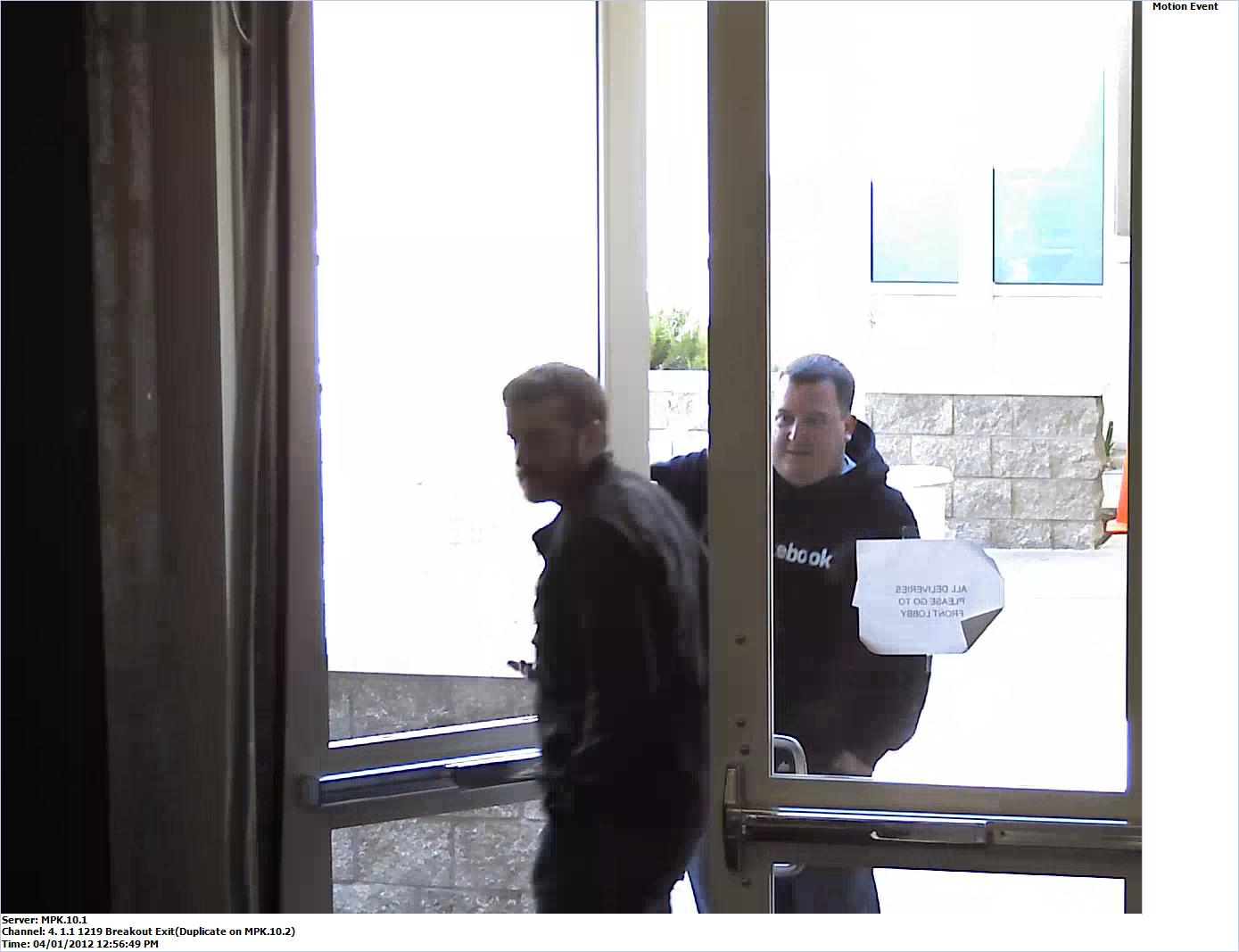
Enlarge/
Ryan McGeehan and another member of Facebook's security team captured
on surveillance camera as they plant the laptop at the heart of Project
Vampire.
Facebook
"The first thing is: 'Oh my God. Panic,'" McGeehan said as he
recalled his team's response to the incident. For almost 24 hours, the
situation gave most employees every indication of being real. "As we're
dealing with this, we realize that our network has been intruded on by
some bad guy. Everyone in this room [is] thinking about 'how are we
going to tear down our entire network? How are we going to basically
deal with the worse-case scenario as a security incident?"
To ratchet up the stress even further, the drill organizers sent an
e-mail to members of Facebook's security team a few hours after the
laptop was disconnected from the Facebook network. The e-mail purported
to come from members of what's known as the Koobface Gang, whose members
last year were identified as the perpetrators of virulent malware
that spread over the social networking site. It made a series of
demands of Facebook and promised serious reprisals if they weren't met.
With Project Vampire, as the drill was dubbed, the employees worked a full 24 hours before they learned it wasn't a real hack.
"We felt it was a necessary thing to have a great security team to
put them through this kind of stuff," Sullivan explained. The organizers
made an exception, however, when early in the drill, an employee said
the magnitude of the intrusion he was investigating would require him to
cancel a vacation that was scheduled to begin the following week.
McGeehan pulled the employee aside and explained it was only a drill and
then instructed him to keep that information private.
Drills that use real zero-day vulnerabilities, require outside
penetration testing firms, and suck up hundreds or thousands of man
hours on non-production activities are expensive to carry out. But in a
post-Operation Aurora world, where companies as security-savvy as Google
and RSA are hacked and ransacked of valuable data, it is becoming
increasingly necessary.
"These things used to be unheard of when back when, except for
governmental type organizations," Trustwave's Havelt said. "Now, you're
seeing this more in the private sector. It's good to see. If it were any
other industry and it was any other critical function of a product not
doing this you'd have people screaming that [the companies] were
negligent and wanting to sue them left and right."

 Posts
Posts


 He said the use of zero-day attacks is rare but by no means unheard
of in "engagements," as specific drills are known in pen-testing
parlance. He recalled an engagement from a few years ago of a "huge
multinational company" that had its network and desktop computers fully
patched and configured in a way that made them hard to penetrate. As his
team probed the client's systems, members discovered 20
Internet-connected, high-definition surveillance cameras. Although the
default administrator passwords had been changed, the Trustwave team
soon discovered two undocumented backdoors built into the surveillance
cameras' authentication system.
He said the use of zero-day attacks is rare but by no means unheard
of in "engagements," as specific drills are known in pen-testing
parlance. He recalled an engagement from a few years ago of a "huge
multinational company" that had its network and desktop computers fully
patched and configured in a way that made them hard to penetrate. As his
team probed the client's systems, members discovered 20
Internet-connected, high-definition surveillance cameras. Although the
default administrator passwords had been changed, the Trustwave team
soon discovered two undocumented backdoors built into the surveillance
cameras' authentication system.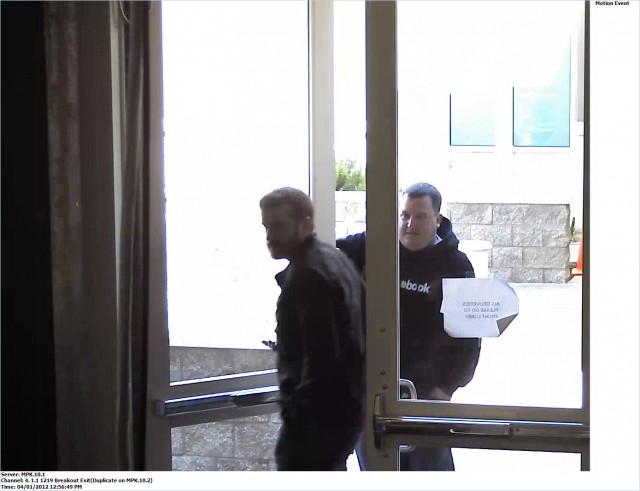


No comments:
Post a Comment