---BREAKAWAY CIVILIZATION ---ALTERNATIVE HISTORY---NEW BUSINESS MODELS--- ROCK & ROLL 'S STRANGE BEGINNINGS---SERIAL KILLERS---YEA AND THAT BAD WORD "CONSPIRACY"--- AMERICANS DON'T EXPLORE ANYTHING ANYMORE.WE JUST CONSUME AND DIE.---
The government has sought to reassure us that it is only tracking
“metadata” such as the time and place of the calls, and not the content
of the calls.
There is substantial evidence from top whistleblowers that the government is recording the content of our call … word-for-word.
And former CIA deputy director – and White House NSA spying panel member – Mike Morrell says thatmetadata is content.
But even accepting the government’s claims at face value, technology experts say that “metadata” can bemore revealing than the content of your actual phone calls.
For example, ARS Technica notes:
The ACLU filed a declaration by
Princeton Computer Science Prof. Edward Felten to support its quest for
a preliminary injunction in that lawsuit. Felten, a former technical
director of the Federal Trade Commission, has testified to Congress several times on technology issues, and he explained why “metadata” really is a big deal.
***
There are already programs that make it easy for law enforcement and
intelligence agencies to analyze such data, like IBM’s Analyst’s
Notebook. IBM offers courses on how to use Analyst’s Notebook to understand call data better.
Court Documents
Unlike the actual contents of calls and e-mails, the metadata about
those calls often can’t be hidden. And it can be incredibly
revealing—sometimes moreso than the actual content.
Knowing who you’re calling reveals information that isn’t supposed to
be public. Inspectors general at nearly every federal agency, including
the NSA, “have hotlines through which misconduct, waste, and fraud can
be reported.” Hotlines exist for people who suffer from addictions to
alcohol, drugs, or gambling; for victims of rape and domestic violence; and for people considering suicide.
Text messages can measure donations to churches, to Planned Parenthood, or to a particular political candidate.
Felten points out what should be obvious to those arguing “it’s just
metadata”—the most important piece of information in these situations is
the recipient of the call.
The metadata gets more powerful as you collect it in bulk. For
instance, showing a call to a bookie means a surveillance target
probably made a bet. But “analysis of metadataover time could reveal
that the target has a gambling problem, particularly if the call records
also reveal a number of calls made to payday loan services.”
The data can even reveal the most intimate details about people’s romantic lives. Felten writes:
Consider the following hypothetical example: A young
woman calls her gynecologist; then immediately calls her mother; then a
man who, during the past few months, she had repeatedly spoken to on the
telephone after 11pm; followed by a call to a family planning center
that also offers abortions. A likely storyline emerges that would not be
as evident by examining the record of a single telephone call.
With a five-year database of telephony data, these patterns can be
evinced with “even the most basic analytic techniques,” he notes.
By collecting data from the ACLU in particular, the government could
identify the “John Does” in the organization’s lawsuits that have John
Doe plaintiffs. They could expose litigation strategy by revealing that
the ACLU was calling registered sex offenders, or parents of students of color in a particular school district, or people linked to a protest movement.
One of the most disingenuous arguments in the aftermath
of the NSA spying revelations is that the American people shouldn’t be
concerned about the government hoovering up its sensitive information
because it’s only metadata–or a fancy way of saying data about the data.
***
A tool developed by MIT Media Lab proves how intrusive the collection
and analysis of metadata is over time, especially for those who are
overly reliant on email as their main method of communication. Dubbed “Immersion,” the tool analyzes the metadata–From, To, Cc and Timestamp fields– from a volunteer’s Gmail account and visualizes it.
***
What you see here is a full analysis of my personal and professional networks over 8.8 years of using Gmail.
***
Metadata, no matter what the detractors say, collected over time is
an intimate repository of our lives–whom we love, whom we’re friends
with, where we work, where we worship (or don’t), and whom we associate
with politically. The right to privacy means our metadata shouldn’t be
collected and analyzed without reasonable suspicion that we’ve done
something wrong.
“Calling patterns can reveal when we are awake and
asleep; our religion, if a person regularly makes no calls on the
Sabbath or makes a large number of calls on Christmas Day; our work
habits and our social aptitude; the number of friends we have, and even
our civil and political affiliations,” Mr. Felten wrote in a legal brief
filed in support of the ACLU’s case.
Metadata equals surveillance.
Imagine you hired a detective to eavesdrop on someone. He might plant a bug in their office. He might tap their phone. He might open their mail. The result would be the details of that person’s communications. That’s the “data.”
Now imagine you hired that same detective to surveil that person. The
result would be details of what he did: where he went, who he talked
to, what he looked at, what he purchased — how he spent his day. That’s
all metadata.
When the government collects metadata on people, the government puts
them under surveillance. When the government collects metadata on the
entire country, they put everyone under surveillance.
High-level NSA whistleblower Kirk Wiebe says that the government prefers metadata to content … since it gives more information.
The ACLU notes:
A Massachusetts Institute of Technology study a few years back found that reviewing people’s social networking contacts alone was sufficient to determine their sexual orientation. Consider, metadata from email communications was sufficient to identify the mistress of then-CIA Director David Petraeus and then drive him out of office.
The “who,” “when” and “how frequently” of communications are often more revealingthan
what is said or written. Calls between a reporter and a government
whistleblower, for example, may reveal a relationship that can be
incriminating all on its own.
Repeated calls to Alcoholics Anonymous, hotlines for gay teens,
abortion clinics or a gambling bookie may tell you all you need to know
about a person’s problems. If a politician were revealed to have
repeatedly called a phone
sex hotline after 2:00 a.m., no one would need to know what was said on
the call before drawing conclusions. In addition sophisticated
data-mining technologies have compounded the privacy implications by
allowing the government to analyze terabytes of metadata and reveal far
more details about a person’s life than ever before.
What [government officials] are trying to say is that disclosure of metadata—the details about phone
calls, without the actual voice—isn’t a big deal, not something for
Americans to get upset about if the government knows. Let’s take a
closer look at what they are saying:
They know you rang a phone sex service at 2:24 am and spoke for 18 minutes. But they don’t know what you talked about.
They know you called the suicide prevention hotline from the Golden Gate Bridge. But the topic of the call remains a secret.
They know you spoke with an HIV testing service, then your doctor, then your health insurance company in the same hour. But they don’t know what was discussed.
They know you received a call from the local NRA office while it was
having a campaign against gun legislation, and then called your
senators and congressional representatives immediately after. But the
content of those calls remains safe from government intrusion.
They know you called a gynecologist, spoke for a half hour, and then
called the local Planned Parenthood’s number later that day. But nobody
knows what you spoke about.
Sorry, your phone
records—oops, “so-called metadata”—can reveal a lot more about the
content of your calls than the government is implying. Metadata provides
enough context to know some of the most intimate details of your lives.
And the government has given no assurances that this data will never be
correlated with other easily obtained data.
“When you take all those records of who’s communicating with who, you can build social networks and communities for everyone in the world,” mathematician and NSA whistle-blower William
Binney — “one of the best analysts in history,” who left the agency in
2001 amid privacy concerns — told Daily Intelligencer. “And when you
marry it up with the content,” which he is convinced the NSA is
collecting as well, “you have leverage against everybody in the
country.”
“You are unique in the world,” Binney explained, based on the
identifying attributes of the machines you use. “If I want to know who’s
in the tea party, I can put together the metadata and see who’s
communicating with who. I can construct the network of the tea party. If
I want to pass that data to the IRS, then I can do that. That’s the
danger here.”
At The New Yorker,
Jane Mayer quoted mathematician and engineer Susan Landau’s
hypothetical: “For example, she said, in the world of business, a
pattern of phone
calls from key executives can reveal impending corporate takeovers.
Personal phone calls can also reveal sensitive medical information: ‘You
can see a call to a gynecologist, and then a call to an oncologist, and
then a call to close family members.’” [Landau gives a more detailed
explanation here.]
“There’s a lot you can infer,” Binney continued. “If you’re calling a
physician and he’s a heart specialist, you can infer someone is having
heart problems. It’s all in the databases.” The data, he said, is “all
compiled by code. The software does it all from the beginning — they
have dossiers of everyone in the country. That’s done automatically.
When you want to investigate or target somebody, a human becomes
involved.”
***
“The public doesn’t understand,” Landau told Mayer. “It’s much more intrusive than content.”
The National Security Agency says that the telephone metadata it collects on every American is essential for finding terrorists. And that’sdebatable. [Indeed, top counter-terrorism experts say that all of this spying doesn’t keep us safe , and that it actually hurts U.S. counter-terror efforts (more here and here).] But this we know for sure: Metadata is very useful for tracking journalists and discovering their sources.
On Monday, a former FBI agent and bomb technician pleaded guilty to leaking classified information to the Associated Press about a successful CIA operation in Yemen. As it turns out, phone metadata was the key to finding him.
***
The real reason the government is going after leakers is because it can. Investigators today have greater access to phone records and e-mails than they did before Obama took office, allowing them to follow digital data trails straight to the source.
***
In a highly controversial move, investigators secretly obtained a subpoena for phone records of AP reporters and editors.
***
Once investigators looked at that phone metadata, they got their big break in the case.
***
It’s no wonder that the Obama administration is going after leakers
so often. Metadata is the closest thing to a smoking gun that they’re
likely to have, absent a wiretap or a copy of an email in which the
source is clearly seen giving a reporter classified information.
***
If you’re looking for a case study in the power of metadata, you’ve found it.
The information collected on the AP [in the recent
scandal regarding the government spying on reporters] was telephony
metadata: precisely what the court order against Verizon shows is being
collected by the NSA on millions of Americans every day.
***
Discussing the use of GPS data collected from mobile phones, an appellate court notedthat
even location information on its own could reveal a person’s secrets:
“A person who knows all of another’s travels can deduce whether he is a
weekly churchgoer, a heavy drinker, a regular at the gym, an unfaithful
husband, an outpatient receiving medical treatment, an associate of
particular individuals or political groups,” it read, “and not just one
such fact about a person, but all such facts.”
Spying on Americans’ metadata rolls back everything our freedom of
association … and virtually everything the Founding Fathers fought for.
Indeed, computer experts
have used an analogy to explain how powerful metadata is: the English
monarchy could have stopped the Founding Fathers in their tracks if they only possessed “metadata” regarding which colonist talked to whom.

 Posts
Posts



 The government has sought to reassure us that it is only tracking
“metadata” such as the time and place of the calls, and not the content
of the calls.
The government has sought to reassure us that it is only tracking
“metadata” such as the time and place of the calls, and not the content
of the calls. calls.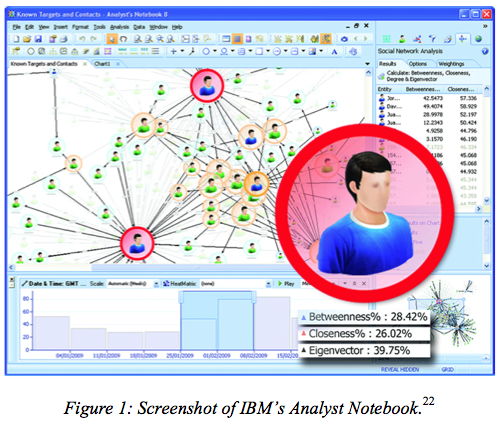


No comments:
Post a Comment