Pages

Wednesday, December 4, 2013

Sandy Hook 911 calls released today. Some things don't make sense after listening to them. Link to recordings.


The Sandy Hook shooting 911 calls were released today. 

I have been listening to them.   There were not that many calls.  I did not hear the one from the woman who said she was at the front office.

Call #3 is the first one from a Rick Thorne, he says there is shooting at the front glass. He says the front glass is all shot out and kept going on. He says the shooting is still happening.  He says everything is in lock down.  Says it is still going on and can't get to the front.  Says he is not in the front but down the other part down a corridor, but close.  But he also says he is no where near there and he only hears shooting/popping.  He says his position with the school is simply acting custodian for the day.   He says it is silent only after 2 minutes.  He says he sees police outside and then he says shooting was still happening.  You can hear police say they got someone in the woods in the background.  He then says there is shooting again, after you can hear the police say they got someone and it had been silent.

How did he know the whole school is in lockdown if he was hiding and he said all the classroom doors were locked.   Also how did he see the glass shot out if he was in another part of the school?


Call #5 saying at 1:37 a woman was shot in the foot in room #1.  at 2:17 the woman is on the phone who was shot.  They never ask her what her name is and she never says what it is.  Yet every other call they ask who they are speaking to.   She also says the classroom door is not locked.

Call 7 at the 2:46 point, Rick has to tell police there at the school there had been a shooting.  How come he had to tell them if there the front glass was broken and I assume bodies were around?  He says the shooting was 5 minutes ago in it.   The police say there are 2 down in the background.

Call 6 is Rick again the temporary custodian 'for the day'.   At the 1:37 mark he is back on the line.  Listen to him say "It is at the Firehouse"


If you think about it, there were only 4, considering Rick is 3 of the recordings.   Others were very fast ones I have not mentioned.

This Is How The NSA Is Tracking You This Instant

Tyler Durden's picture


http://www.zerohedge.com/news/2013-12-04/how-nsa-tracking-you-instantThat little "entertaining" cell phone in your back pocket, which you are so addicted to thanks to all its apps, videos, messaging function and all other cool bells and whistles, that you can't possibly live without? It is simply the definitive NSA tracking beacon used to find where you are at any given moment. The following infographic explains how the NSA does just that...

Source: WaPo

4 Ways to Heal and Replenish our Damaged Soil and Food Supply

Christina Sarich
soil healing 263x164 4 Ways to Heal and Replenish our Damaged Soil and Food SupplyIt’s a known, disappointing fact that genetically modified foods and modern farming practices have wrecked our soil. Research coming from multiple studies reveals that Bt toxins ruin the very earth that allows such abundant plant life to grow on this planet. Earthworms and natural microbes as well as beneficial insects that help our plants grow into vital fruit and vegetable-giving sustenance are no longer looked at as viable options for farming or gardening. We have nuked the soil with pesticides and herbicides, which has largely contributed to the massive decline in our foods nutritional value.
Thinking about dirt may not be glamorous, but it is essential to organic and sustainable farming. While the soil is damaged from GMO, it may not be irrevocable – yet. But we need to act soon if we want to save our soil and the food supply.
Research from New York University says that Bt toxins actually accumulate in soil by binding to humic acid in soil particles. Usually the microbes in soil degrade free toxins (those which occur naturally), but with Bt toxins, they endure so that they can retain their capacity to kill insects. This, in turn, causes a major problem in the soil ecosystem. Bt toxins stay active and enter the insect’s gut, where it basically disintegrates their intestines. This is why farm animals are behaving in a similar manner when they are fed a diet of GMO corn or soy.
Good, healthy, organic soil has no Bt toxins, and no herbicides or pesticides. It is a mixture of sand clay and silt, and a host of microscopic life, which arises from dead and decaying things like leaves, other plants, etc. Real soil is part of the cycle of life. It requires cooperation with these cycles of nature in order to be healthy. When we allow this to happen instead of eradicating all the ‘nutrients’ that are really this combination of living as well as dead and dying parts of nature, then we get healthy, prolific plants that produce bumper crops of apples, zucchini, corn, tomatoes, potatoes, spinach, cauliflower, and so much more.

4 Ways to Repair Damaged Soil

What’s more, is we can add soil amendments to help Mother Nature along instead of making it so difficult for anything to grow. Here are just a few examples of ways we can support good soil instead of using toxic chemicals:
  • 1. Compost – You can turn your kitchen scraps, dead leaves, and even unbleached paper napkins into some great compost soil for your plants. If you buy yours from a local nursery instead of making it yourself and it smells like urine, then the nitrogen content is too high. If you make your own, you can make sure that the nitrogen levels are balanced with other important nutrients that should be in your soil. You can even make your own compost bin and start healing your soil today.
  • 2. Leaf Humus – This is really just a different type of compost. Instead of raking up leaves and throwing them away, allow them to compost. They make a very balanced soil amendment that has balanced Ph levels to add to your garden.
  • 3. Manure – Many farmers and gardeners rave about chicken poop. All animal manures should be composted for at least 90 days before putting them on plants you plan to eat. But when done right, animal manure can be great fertilizer, and it actually isn’t full of toxic chemicals.
  • 4. Crop Rotation - We’ve all heard of peak oil, but less notice has been paid to peak phosphorus and potassium, two of the three key elements in agriculture that allow plants to take root and thrive. (The other element is nitrogen.) Our ancestors rotated fields to allow soil to rest after each harvest to prevent such nutrient depletion, and since the identification of these elements in the 19th century, we’ve put food and animal (sometimes human) waste back into the earth as what began to be called fertilizer in the 20th century. Respecting natural rotation and farming techniques, however, is something Big Ag hasn’t bothered to do.
The best soil amendments feed both the soil and the plants, not deplete them, and definitely don’t ruin them for generations to come as GMO crops do. Keeping this earth fertile starts with good, healthy soil.

Transgene Escape: GMOs Spreading Uncontrollably Around the World

naturalsociety.comhttp://naturalsociety.com/gmos-spreading-uncontrollably-around-world/

Transgene Escape: GMOs Spreading Uncontrollably Around the World

Elizabeth Renter
Elizabeth Renter
by
December 2nd, 2013
Updated 12/02/2013

gmofieldlightning transgene 263x164 Transgene Escape: GMOs Spreading Uncontrollably Around the World
Image from testbiotech.org used.
Testbiotech, a nonprofit organization started with independent (‘non-biased’) biotech research in mind, recently released a report on the spread of genetically altered plants. The organization says GMOs are spreading throughout the world without any controls in place to stop them. They have escaped their intended areas and are moving into the environment and even infringing on wild plant populations. This is happening everywhere and something must be done to stop it before it worsens.
In the U.S., Canada, Central America, Japan, China, Australia, and Europe, genetically modified organisms are spreading into the food system. This is happening with corn, rice, cotton, flaxseed, bentgrass, and poplar trees, according to the Testbiotech report.
“Coexistence between genetically engineered crops and biodiversity is not possible if crops are spreading into wild populations without control. Industry is contaminating biodiversity and our future seeds – who will hold them responsible?” says Margarida Silva from the GMO-free Platform in Portugal, according to GM Watch.
Just 3 examples of GM contamination can be seen here:
  • GM Wheat – An unapproved strain of genetically modified wheat was discovered in an Oregon field earlier this year. The Roundup Ready strain was nixed in 2005 when global resistance to Monsanto forced the company to stop working on it. It was never approved for use, let along growing and exporting.
  • GM Rice – During 2006 and 2007, three different strains of genetically modified rice were found in US rice exports and subsequently the world over. There were three specific strains of rice—one of which was approved in the U.S. and the other two which were not. Still, none of the strains were approved for cultivation or consumption anywhere else in the world. In total, the GM rice was found in more than 30 countries.
To make matters worse, the USDA now considers GMO contamination “normal”.
Testbiotech says there are several reasons for “transgene escape”. They say the future impact of this unregulated spread of GM technology is, quite simply, unknown.
Apart from commercial cultivation and experimental field trials, losses from the import and transport of viable grains for food and feed production are a source of uncontrolled dispersal. The consequences cannot be reliably predicted, and from the cases documented in the overview it is evident that no prediction can be made on how these plants will behave in the long-term or interact with biodiversity.
The organization is calling on EU Commissioner Tonio Borg, who is pushing for GMO authorization throughout the EU, to honestly assess the consequences of GM technology.
Christoph Then for Testbiotech says, “EU Commissioner Tonio Borg who is currently pushing for the authorisation of genetically engineered plants in the EU, should be aware of the consequences of this technology on a global scale. We need regulations to ensure that the release of genetically engineered organisms is prohibited unless they can be removed from the environment if required.”
But, if they’ve infiltrated even wild plant relatives, removal is doubtful.
The entire report, entitled “Transgene Escape: Global atlas of uncontrolled spread of genetically engineered plants,” can be found here.

SWEDEN: Patriots take to the streets to protect Stockholm from Muslim rioters

Apparently, the police don’t want to. Or perhaps the dhimmi Swedish government told them to stand down?

Swedish nationalists who gathered in Stockholm to patrol the streets, after the police chief admitted they were dong nothing to stop the riots.

TCN (h/t Colin W)  Following an announcement by the Stockholm chief of police that they were not going to fight the rioters, nationalists in Sweden began organizing patrols. Muslim immigrants, largely Somalians, have been rioting and setting fires since Sunday night.

Reports are being posted online that large numbers of young Swedish men are now patrolling Stockholm and battling with the Muslim rioters.

The Swedish media states that a large number of police mobilized to prevent “50 right-wing extremists” from patrolling the streets of Tumba, a suburb of Stockholm.

SDL-Göteborg-demo-ad-e1373915525424
mind control
We are moving into a time when the extraordinary advances that have been made in the fields of nanotechnology, neurology, psychology, computer science, telecommunications and artificial intelligence will be used by governmental authorities to control the population?  Already, governments around the world are using the threat of “terror” as an excuse to watch us, track us, scan all of our electronic communications and force us to endure “security measures” that are so extreme that even George Orwell could have never dreamed them up.   So what is going to happen one day when some crazed individual actually does set off a weapon of mass destruction in a major city?  The temptation to use these emerging technologies to control the public will become almost irresistible.  At this point “mind control” is still a dirty word to many, but after the next couple of “9/11 style events” the general population will be crying out for something to be done to ensure their security.  When society experiences a complete and total meltdown in the years ahead, governments around the world will be tempted to do just about anything, including using mind control, to restore order.  That is why some of the most recent advances in the field on nanotechnology are so chilling.
In particular, what a team of researchers at the University at Buffalo have discovered is truly alarming.  The following is an excerpt from their recent news release….
Clusters of heated, magnetic nanoparticles targeted to cell membranes can remotely control ion channels, neurons and even animal behavior, according to a paper published by University at Buffalo physicists in Nature Nanotechnology.
Using nanoparticles to remotely control animal behavior?
It doesn’t take a doctorate to understand the implications of such a technology.
What if “nanobots” that had the capacity to control human minds were programmed to search out and attach themselves to key areas of the human brain?
Such “nanobots” would be far too small to even be seen by the human eye, and people could become “infected” with these creatures without even knowing it.
Hordes of these nanobots could be released into the atmosphere or in public areas and infect thousands (or even millions) and nobody might even realize it.
If governments could find a way to use nanobots to remotely control the minds of the general population, a mass mind control program could be implemented without the general public even realizing what is going on.
Yes, this is just how scary this technology is.
But it gets even worse.
mind
You see, when it comes to nanotechnology we are dealing with something far more dangerous than we can even imagine.
For example, if something goes horribly wrong and we develop speed-breeding self-assembling nanobots that get out of control, they could theoretically devour all life on Earth in fairly short order.
Think of the scene at the end of the recent Keanu Reeves movie entitled “The Day The Earth Stood Still” and multiply it by about a million.
But even if such a scenario never plays out, the mind control potential of nanotechnology is bad enough.
Not that other mind control technologies aren’t equally as dangerous.
The truth is that all kinds of mind control technologies are being developed.
Video game makers are busy developing games that you control not with a joystick or a gamepad but rather with your brain waves.  So could such a technology someday be used in reverse?
Of course most people by now have heard of  MK-ULTRA and other mind control programs that were developed by the CIA and other U.S. government agencies.
The U.S. government insists that all such programs have been discontinued.
But are they telling the truth?
nano brain
And what are other governments around the world developing in secret?
There are other mind control technologies out there that are incredibly dangerous as well.
In fact, there are many who suggest that electromagnetic waves could potentially be used to control thoughts and influence behavior.  Think of what just one terrorist could do with such technology.
But one of the most disturbing developments of all is the increasingly rapid merger of men and machines that is now taking place.
People have been looking for ways to stay more “connected” to the Internet for a long time, and now some are actually suggesting that we should find a way to directly connect our brains to the Internet.  A recent article on the website of the Science Channel put it this way….
What if it were possible to connect your brain to the Internet, either wirelessly or through a cable, download digital information at high speed, and then translate it automatically into a chemical form that could be stored by your brain cells as memory?
The same article explained what some of the benefits from such a connection might be….
If you could pump data directly into your gray matter at, say, 50 mbps — the top speed offered by one major U.S. internet service provider — you’d be able to read a 500-page book in just under two-tenths of a second.
But what about the dangers?
What if the Internet could end up controlling you?
Or what if a really bad computer virus was downloaded into your brain?
Think it can’t happen?
nsa
Well, British researcher Mark Gasson infected an RFID chip in his hand with a computer virus and found that the virus-infected chip implanted in his hand was able to contaminate external systems.
Imagine if that started happening on a large scale.
And someday it might.
Especially as we approach the time that futurists refer to as “The Singularity”.
The Singularity is hard to define, but basically many futurists believe that the merging of man and technology is happening at such an increasingly rapid pace that at some point the new “transhumans” will become virtually incomprehensible to normal human beings.  The idea is that by merging man and machines, transhumans will become smarter, stronger, healthier and more powerful than we could have ever dreamed possible.
So will men and computers fully merge someday?
Let’s hope not.
neurochip
But even now, an increasing number of people are developing ways to tag humans with RFID microchips.
In fact, one company called Somark has developed a breakthrough in chipless RFID ink.  Their “RFID tattoos” are applied using a geometric array of micro-needles and a reusable applicator with a one-time-use ink capsule.
So how easy is it to apply one of these RFID tattoos?
Well, it takes about 5 to 10 seconds to tattoo an animal or a human.  Once the tattoo has been applied, an RFID reader can read it from up to four feet away.
But who needs a tattoo?  IBM has actually announced that they have developed a “bar code reader” that can read your DNA.
Very frightening stuff.
The truth is that the vast majority of people do not want their DNA scanned and they do not want RFID chips implanted into them.
But RFID chips are being implanted into people more than ever before.
The reality is that microchipping of humans is becoming quite commonplace in the United States.  For example, RFID implants are being implanted in thousands of elderly Americans living with Alzheimer’s disease who are at risk of wandering off and getting lost.  In addition, RFID chips are being implanted into many people who are chronically ill so that doctors can access their medical information quickly in an emergency.
The truth is that there are some people who are quite eager to be chipped.  One columnist named Don Tennant recently published an article entitled “Chip Me – Please!” in which he expressed his excitement that Barack Obama’s new health law may include coverage for RFID chip implants that contain patient identification and health information.  In fact, Tennant makes the following stunning admission in his article….
All I can say is I’d be the first person in line for an implant.
So is this our future?
Is everyone going to be taking lots of microchips and implants?
Will there come a day when microchips and implants are made mandatory?
After all, what better way to truly identify someone?  Identification cards and papers can be forged or can get lost.  But if you implant someone with a microchip how are they going to lose that?
However, we all know that the potential for abuse of all of the technologies mentioned in this article is just too great.  If someday a tyrannical regime gets a hold of these kinds of ultra-powerful technologies the results could be absolutely nightmarish.
Original:  http://endoftheamericandream.com/archives/mind-control-scientists-have-discovered-how-to-use-nanoparticles-to-remotely-control-behavior

http://countdowntozerotime.com/2013/12/04/government-chemist-tampered-with-40000-cases-locking-countless-innocent-americans-in-prison/

Dookhan_Drug_Suspensions 


MASSACHUSETTS — In a maddening scandal that is rocking the state of Massachusetts, a government crime lab chemist has been caught intentionally forging signatures and tampering with evidence in as many as 40,000 cases, destroying the lives of countless innocent Americans.
Annie Dookhan worked as a chemist for the State of Massachusetts, and it turns out she had close relations with prosecutors.
These prosecutors were able to successfully convict innocent Americans because Dookhan would chemically taint the “evidence,” resulting in career boosts for the prosecutors while innocent men and women were torn from their families and locked in cells.
Prosecutors praised Dookhan’s work and depended on her to get the convictions they wanted.
Hundreds of “convicts” and defendents have already been released, and there are potentially thousands more waiting to be set free.


Norfolk County District Attorney Michael Morrissey is reviewing thousands of files to determine which cases must be thrown out or retried because of potentially tainted evidence. | Source: Tovia Smith/NPR


Norfolk County District Attorney Michael Morrissey is reviewing thousands of files to determine which cases must be thrown out or retried because of potentially tainted evidence. | Source: Tovia Smith/NPR
Dookhan used her position to forge results for nearly a decade.  ”I don’t think anyone ever perceived that one person was capable of causing this much chaos,” said Norfolk County District Attorney Michael Morrissey.
“You can see the entire walls full of boxes… in one of these cardboard boxes, there could be hundreds of cases … in each box,” said Morrissey.
Hundreds of defendants and “convicts” had been arguing that they were framed and claiming that the evidence used to convict them was mishandled. They were right.
In one recent case, a man was charged with “selling cocaine and heroin.”  His public defender, Julieann Hernon, believes that this man was a potential victim of Dookhan’s fake evidence and ought to be released.
“[Dookhan] was mis-testing evidence, dry-labbing evidence, saying she had ‘conducted tests’ when she had not, deliberately tainting drugs,” said Hernon.
“Certainly, I think, we have to presume a taint here when Annie Dookhan was the chemist in the case,” said Hernon.
In another recent case, defense attorney William Sullivan was able to successfully reverse his client’s prior “guilt” because Dookhan was the secondary chemist involved in the conviction.


Man in prison
“This is a lab that was pretty much wholly and fully contaminated by Ms. Annie Dookhan,”Sullivan told the judge. “She had full access to everyone’s drugs.”
While many have been set free, they will never get the lost years of their lives back.
“The tragedy is that my client already did four years on this,” said Sullivan. “I mean, that is disturbing in itself.”
Many other innocents have lost their careers, lost their children, and lost their marriages.
Michael Morrissey, Norfolk County District Attorney, is now sifting through thousands of files to find out which should be thrown out because of Dookhan’s corruption and deceit.
In federal court, many innocents received even harsher sentences due to prior convictions based on Annie Dookhan’s fake “evidence.”
Several civil suits are getting started by those accused of crimes based on Dookhan’s tampering, accusing Dookhan of trampling on their rights to fair trials.
more
BREAKING (11/30/13): Another Chemist at Dookhan’s Lab Accused of Deception, More than 180,000 Cases Need Review

Chinese State Media Brags of Plan to Establish “Death Star” Moon Base


Beijing wants lunar base to launch missiles against any target on Earth
Paul Joseph Watson
Infowars.com
December 4, 2013
A report appearing in the pro-regime China Times brags that China’s launch of the Long March-3B rocket earlier this week is part of a long term plan to turn the moon into a Star Wars-style “death star” from which the PLA could launch missiles against any target on Earth.
Image: Long March-3B Rocket (YouTube).
It all sounds like something straight out of The Onion, but upon checking the sources it appears that this is indeed what Communist Party officials have been discussing this week following China’s flagship launch of a lunar rover, which is Beijing’s first spacecraft to land on the surface of an extraterrestrial body.
The article appears on the Want China Times website, the English-language outlet of the The China Times Group, which is based in Taiwan and considered to be pro-unification and pro-Beijing. The article cites the Beijing Times, which is affiliated with the People’s Daily, as the source for the original report.
Under the headline PLA dreams of turning moon into Death Star, says expert, the report cites “experts in China” who are wargaming how the moon, “Can be transformed into a deadly weapon. Like the Death Star in Star Wars, the moon could hypothetically be used as a military battle station and ballistic missiles could be launched against any military target on Earth.”
“Various weapons testing sites could also be established on the moon,” the article adds, noting that the launch of the Long March-3B rocket is the start of “a more ambitious program.”
This report again reminds us that some of Beijing’s most jingoistic and aggressive rhetoric is often hidden in plain view, with Chinese military planners perfectly willing to go on the record and brag about their agenda to turn China into a forceful military superpower.
Last month, Chinese state-run media released a map showing the locations of major U.S. cities and how they would be impacted by a nuclear attack launched from the PLA’s strategic submarine force.
Top Chinese generals have also occasionally threatened America with nuclear strikes if the U.S. becomes embroiled in any future conflict involving Taiwan.
Tensions between the United States and China are currently running high after Beijing imposed an “air defense zone” over the disputed Senkaku Islands and hinted that it may shoot down any foreign aircraft entering the area. The U.S., Japan and South Korea quickly rendered this threat toothless by performing several overflights of the area without notifying Chinese authorities.
According to the Telegraph’s Ambrose Evans-Pritchard, the escalating crisis represents a “watershed moment for the world,” could signal the start of a new cold war, and means “Asia is on the cusp of a full-blown arms race.”
China has acted with increasing military aggression in recent months, first by sending warships to the coast of Syria to in September to “observe” the actions of U.S. and Russian vessels in the region and then by sailing a surveillance ship through Hawaiian waters for the very first time in an unprecedented move which was described as a provocative retaliation to America’s naval presence in the East China Sea.

GMO, Additives, Contaminants and Pesticides. European “Food Safety” on Behalf of the Food and Drink Conglomerates

Our food in their hands: Whose interests does the European Food Safety Authority serve?


food
According to the website of the European Food Safety Authority (EFSA), it is the keystone of European Union (EU) risk assessment regarding food and feed safety. The website also states that the EFSA provides independent scientific advice and clear communication on existing and emerging risks and that it is an independent European agency funded by the EU budget. The authority operates separately from the European Commission, European Parliament and EU Member States.
Nice sounding words, but over half of the 209 scientists sitting on the agency’s various panels have direct or indirect ties with the industries they are meant to regulate. Indeed, according to a recent independent screening performed by Corporate Europe Observatory (CEO) and freelance journalist StĂ©phane Horel, almost 60% of experts sitting on EFSA panels have direct or indirect links with industries regulated by the agency.
The report ‘Unhappy Meal. The European Food Safety Authority’s independence problem’ identifies major loopholes in EFSA’s independence policy and finds that EFSA’s new rules for assessing its experts, implemented in 2012 after several conflicts of interest scandals, have failed to improve the situation (1).
The authors warn that this situation casts a severe doubt on the credibility of the scientific output of the key body responsible for food safety at the EU, with the agency issuing recommendations and risk assessments on crucial public health issues such as food additives, packaging, GMOs, contaminants and pesticides.
According to the report, the EFSA’s new rules for assessing its experts’ interests enable dozens of experts with multiple commercial interests (consultancy contracts, research funding, etc) to still be granted full membership of EFSA panels, including a majority of panel chairs and vice-chairs.
Main author Stéphane Horel said:
“We were shocked by our findings. Even without checking for undeclared interests, the number of conflicts of interest in this agency is very worrying. Experts with conflicts of interest dominate all panels but one. We found that the bulk of conflicts are from research funding and private consultancy contracts, but certain crucial institutions for scientists (scientific societies, journals) are also targeted by industry lobbying, and EFSA seems to ignore this”.
 The report also shows that EFSA failed to properly implement its own new rules in several instances and that there is no visible difference between panels assembled under the new policy and those composed using the old policy.
Martin Pigeon, researcher and campaigner at CEO, said:
“There are specific cases the agency was warned about years ago which remain a problem… We hope this report is an eye-opener on the necessity to defend public research integrity from the threats posed on public health by industry influence”.
Further concerns
On the heels of that report now comes the news that the European Commission’s Health and Consumers Directorate (SANCO) has short-listed a director of the biggest EU food industry lobby group FoodDrinkEurope among the candidates to the Management Board of the EFSA (2).
Ms Beate Kettlitz works in a leading position for the lobby group, which represents all major European food and drink corporations. Moreover, it is the second year in a row that the Commission has tried to appoint representatives from FoodDrinkEurope as Members of EFSA’s Management Board.
A year ago, the European Commission nominated FoodDrinkEurope’s Executive Director Mella Frewen (a former Monsanto lobbyist). Her appointment was rejected by the European Parliament and the Member States.
EFSA’s Management Board is key: it is the food agency’s governing body. Everyone eating food in Europe is affected by its decisions.
Martin Pigeon of CEO:
“The fact that the European Commission shortlists a food industry lobbyist, once again, for EFSA’s Management Board is an incomprehensible signal for all those concerned about the protection of consumers and the environment. Such a professional on EFSA’s board would by definition be a permanent threat to the EU’s food safety agency’s independence”
Seven seats on EFSA’s Management Board are up for renewal in June 2014. The European Commission has published a list of 23 names, mostly from national food safety agencies, research institutes and academia for the EU Parliament’s consideration and the Member States’ decision. But four persons among those short-listed also have interests in the food industry:
  •  Jan Mousing, re-applying for the position, is the CEO of the Danish Knowledge Centre for Agriculture, a private company describing itself as the “main supplier of professional knowledge for the agricultural professions” in Denmark;
  • Piet Vanthemsche, who is also re-applying for the position, holds a leading position in industrial farmers union COPA and also sits in MRBB holding, an agri investment fund which also has shares in companies selling GMOs.
  • Alan Reilly, Chief Executive of the Irish Food Safety Authority (Ireland’s public food safety administration), is also a member of the Scientific Advisory Board of the European Food Information Council (EUFIC), a Brussels-based food lobby group financed by the some of the largest private food and drink companies in Europe.
  • Milan Kovac, from the Slovak Ministry of Agriculture, was a board member of ILSI Europe until 2011. ILSI Europe, an industry research institute supported by all the biggest agrofood multinationals, is a central actor in the agrofood industry’s scientific influence over EFSA.
The Commission’s justification for these nominations is an industry-friendly interpretation of EFSA’s founding regulation, which states that four of the 14 board members “shall have a background in organisations representing consumers and other interests in the food chain”.
In their recent joint press release, CEO and Testbiotech note that nowhere is it mentioned that the food industry should be involved, in fact quite the contrary: EFSA’s 2011 independence rules stipulate that “persons employed by industry shall not be allowed to become members of EFSA’s Scientific Committee, Scientific Panels and working groups.”
Such trends are worrying to say the least. Writer and researcher William F Engdahl has already alluded to a ‘cancer of corruption’ between the biotech sector and the EFSA (3). And this year, Friends of the Earth Europe (FoE) and GM Freeze released their own research report that expressed serious health-related concerns over the excessive and largely unmonitored use of glyphosate (weedkiller) in Europe (4). Very valid concerns, considering recent research pertaining to the health impacts (5). In 2011, Earth Open Source said that official approval of glyphosate had been rash, problematic and deeply flawed. A comprehensive review of existing data released in June 2011 by Earth Open Source suggested that industry regulators in Europe had known for years that glyphosate causes birth defects in the embryos of laboratory animals. Questions were thus raised about the role of the powerful agro-industry in rigging data pertaining to product safety and its undue influence on regulatory bodies (6).
The aim of powerful private companies is to make money, to maximise profit for shareholders. Any safety requirements are secondary concerns, if they are concerns at all. Therefore, we expect bodies like the EFSA to take up these concerns on our behalf and to resist the food lobby and agribusiness in their attempts to translate their massive financial clout into political influence, not least where its own Management Board and ‘expert pasnels’ are concerned.
On its website, the EFSA states:
“Food is essential to life. We are committed to ensuring food safety in Europe.”
Is it?
Get involved, be informed and resist corruption and the corporate takeover of Europe: Visit http://corporateeurope.org/get-involved#
 Notes

They’re Going to Dump the Fukushima Radiation Into the Ocean

Region:
fukushimaNuclearPlume_2011

Yup … They’re Going to Dump It

Tepco is planning on dumping all of the radioactive water stored at Fukushima into the ocean.
The industry-controlled nuclear regulators are pushing for dumping the radiation, as well.
As EneNews reports:
Juan Carlos Lentijo, head of IAEA’s mission to Fukushima Daiichi, Dec. 4, 2013: “Controlled discharge is a regular practice in all the nuclear facilities in the world. And what we are trying to say here is to consider this as one of the options to contribute to a good balance of risks and to stabilize the facility for the long term.”
Shunichi Tanaka, chairman of Japan’s Nuclear Regulation Authority, Dec. 4, 2013: “You cannot keep storing the water forever. We have to make choice comparing all risks involved.”
Xinhua, Dec. 4, 2013: Lentijo said that TEPCO should weigh the possible damaging effects of discharging toxic water against the total risks involved in the overall decommissioning work process. [...] Tanaka highlighted the fact that while highly radioactive water could be decontaminated in around seven years, the amount of water containing tritium will keep rising, topping 700,000 tons in two years. [...] nuclear experts have repeatedly pointed out that [tritium] is still a significant radiation hazard when inhaled, ingested via food or water, or absorbed through the skin. [...] fisherman, industries and fisheries bodies in the Fukushima area and beyond in Japan’s northeast, have collectively baulked at the idea of releasing toxic water into the sea [...] TEPCO will be duty-bound to submit assessments of the safety and environmental impact [...]
NHK, Dec. 4, 2013: IAEA team leader Juan Carlos Lentijo [...] said it is necessary and indispensable to assess the impact the tritium discharge might have on human health and the environment, and to get government approval as well as consent from concerned people.
Japan Times, Dec. 4, 2013: “Of course . . . public acceptance for this purpose is necessary,” said Lentijo, adding strict monitoring of the impact of the discharge would also be essential.
AFP, Dec. 4, 2013: [L]ocal fishermen, neighbouring countries and environmental groups all oppose the idea.
See also: Gundersen: They want to dump all Fukushima’s radioactive water in Pacific — Tepco: It will be diluted, then released — Professor suggests pumping it out in deep ocean (VIDEOS)
In the real world, there is no safe level of radiation.
And there are alternatives.
Dr. Arjun Makhijani  – a recognized expert on nuclear power, who has testified  before Congress, served as an expert witness in Nuclear Regulatory Commission proceedings, and been interviewed by many of the largest news organizations – told PBS in March:
We actually sent a proposal to Japan two years ago, some colleagues of mine and I, saying you should park a supertanker or a large tanker offshore, and put the water in it, and send it off someplace else so that the water treatment and the water management is not such a huge, constant issue. But [the Japanese declined].
Tepco – with no financial incentive to actually fix things – has been insanely irresponsible and has only been pretending to contain Fukushima. And see this.
Unfortunately, Japan has devolved into crony capitalism … and even tyranny.
So instead of doing something to contain the radiation, they’re going to dump it.
Postscript: In related news, the Japanese government has embarked on a massive program of burning radioactive waste throughout Japan … instead of encapsulating it in glass or otherwise containing it.

New Spotify report debunks “per stream” payments for artists

Artists are paid based on popularity, according to Spotify's writings.

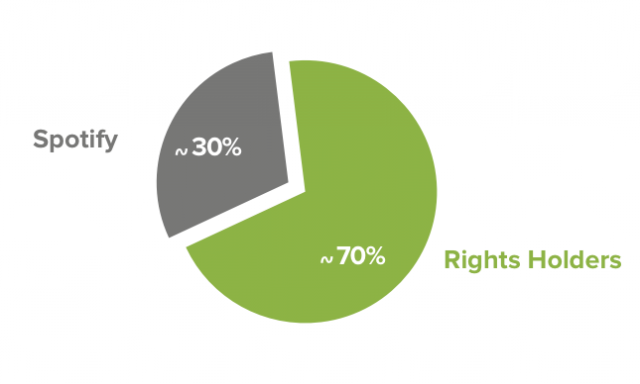
If what Spotify pays out to rights holders (~70 percent of what they're due, based on popularity), only some of that may go to the artist themselves.
In a report published Tuesday, Spotify revealed the inner workings of its payout systems for artists with music available on the service. The company debunked the claim that the service pays per stream, revealing that things are slightly more complex.
Rather than a flat rate per play of a song, Spotify considers the success of an artist relative to the entire Spotify ecosystem to determine how much money they get. Royalties for, say, one song are paid out based on the proportion of plays it gets out of all of the plays Spotify doles out in a given time period.
There are other factors to the payout formula. How much revenue Spotify earns in a month determines the total amount of royalty money available on a country-by-country basis. After that, Spotify does the math on how much traffic a given artist constituted for the month. For instance, if Spotify has $100 in royalty money from one country and an artist represented 0.01 percent of that month’s streams, the payout for that country would be 0.01 cents.

Enlarge / Popularity is everything.
Of that proportion, Spotify keeps 30 percent for itself, and 70 percent goes to the “master and publishing owners.” So if the music is owned by a label, the 70 percent goes there; if the music is owned by the artist, the payout goes directly to the artist. The 70 percent figure appears to be a bit flexible. Spotify writes in the post that it "negotiates... royalty economics with labels and publishers in each territory." From there, if the artist operates on a royalty rate under their label, the artist is then paid out of that 70 percent of the tiny proportion of money their music represents in Spotify’s overall traffic.
The report comes as a response to individual artists reporting the money they’ve earned from the service, which often appears to be piddling and is almost always reported as “per stream.” Musician Zoe Keating revealed in August that she earned $808 from 201,412 streams of her two albums on Spotify, a return of 0.4 cents per play, during the first six months of 2013.
According to Spotify’s accounting, Keating’s return is low. Spotify claims that it’s putting out “an average 'per stream' payout to rights holders of between $0.006 and $0.0084” (0.6 to 0.84 cents). And while a per-stream rate can be reverse-engineered from an artist’s total payout, Spotify was actually using the proportional system above to determine payout instead of the sheer number of plays.
Artists have noted in the past that Spotify appears to pay differently per stream depending on whether that stream was by a paid-premium user or a user whose listening is ad-supported. Spotify states that this is a factor in determining the overall revenue pot, but the company doesn’t include it in the formula for determining the revenue per artist.
In November 2012, musician Damon Krukowski wrote on Pitchfork that Spotify negotiated royalty rates individually for each label, and that his label received the “going ‘indie’ rate” of 0.5 cents per play. This was then adjusted per some of the factors above outlined in “small, invisible print,” like the number of listeners who are subscribers vs. ad-supported. Krukowski wrote that this meant Spotify should have owed his label $29.80 for 5,960 plays; instead, he was paid $9.18.
Spotify’s story doesn’t quite account for this alleged process, so it’s unclear whether its method changed since last year or if “going rates” are given as a sort of ballpark figure to set expectations. When asked about Krukowski’s account, Graham James, head of US communications for Spotify, told Ars that “the amount that labels get from Spotify is the same across labels." James continued, “I don’t know where he got that information from… it’s incorrect if he’s saying he negotiated a per-stream rate.”
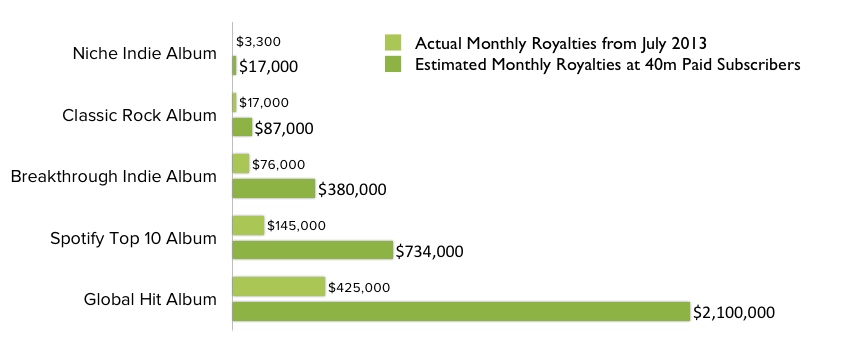
In its report, Spotify goes on to give estimates on what artists of different profiles can expect to earn. Using real, anonymized figures, Spotify states that a “niche indie album” earned $3,300 for the month of July 2013, while a “global hit album” earned $425,000.

Enlarge / Payouts for different types of albums in July 2013, alongside what Spotify estimates it will be able to pay once it hits 40 million subscribers.

Spotify only specifies in the report that these were “actual” numbers, but not whether they were any kind of average or whether the albums were new or recent releases. Mark Williamson of Spotify Artist Services tells Ars that “one [album] is a current top 10 [on] Spotify, one is a current global hit—they’re all fairly current.” The Independent writes that the Daft Punk single “Get Lucky” alone earned $1.08 million on 78.6 million plays. Spotify goes on to make projections about what artists might earn when the service reaches 40 million subscribers, which is what the company estimates its base will be once it “[reaches] a similar scale to Spotify’s most mature markets.” At that point, it says, a niche indie album could expect to earn $17,000 in a month, while a global hit album would get $2.1 million.
Spotify aims to get across in the report that it does not pay artists per stream and that such a figure is inadequate for assessing an artist's value. Spotify revenue is essentially a giant shared pie between artists—one that fluctuates in size depending on subscriber numbers, types, and locations. Once that lump sum is calculated, Spotify determines the size of the artist’s slice based on their proportion of streams. This is in contrast to a radio-style service like Pandora, which does pay a royalty each time a song is played. The Pandora royalty is based on negotiations and not total proportions of traffic.
Such a system doesn't favor bigger artists and huge hit songs, but in an ecosystem like Spotify’s, their popularity appears to cost the smaller artists. The harder a big artist hits with a new song or album, the more streams they add to Spotify’s overall bulk and the smaller everyone else’s payout from the finite, monthly Spotify revenue pool becomes.
All this said, the size of Spotify’s total revenue pool is on the rise. The company has already cracked $500 million in payouts, up from roughly $150 million in 2011. “Our payouts for individual artists have grown tremendously over time as a result of our user growth, and they will continue to do so,” the company writes.

NSA collects nearly 5 billion cellphone location records per day

Washington Post report (based on Snowden leaks) reveals a possible 27 TB database.

Today, The Washington Post added another noteworthy finding to the growing pile of information leaked by former NSA contractor Edward Snowden: the NSA is collecting nearly five billion cellphone location records per day from across the world. The Post reports that this initiative allows the NSA to track individuals and map relationships "in ways that would have been previously unimaginable."
This gigantic data collection feeds a database that stores information on "hundreds of millions of devices," according to the documents obtained by The Post. One estimate puts the size of this at 27 terabytes, which the paper frames as twice as large as the text content in the Library of Congress's print collection. It's so big that a 2012 NSA internal briefing recognizes the data is "outpacing our ability to ingest, process, and store."
And while the NSA doesn't focus this initiative specifically on Americans, the massive amount of information means plenty of that does pertain to US phones "incidentally," which The Post translates as a "foreseeable" but not "deliberate" result. The paper spoke with an intelligence lawyer who continued to emphasize that this program focuses beyond the US, which seems to prevent the data from falling under the Fourth Amendment (unreasonable search and seizures).
To physically collect all this data, the NSA uses 10 “sigads,” or signals intelligence activity designators. The Post describes one sigad to demonstrate the setup (they also have a graphical breakdown of the NSA collection process):
A sigad known as STORMBREW, for example, relies on two unnamed corporate partners described only as ARTIFICE and WOLFPOINT. According to an NSA site inventory, the companies administer the NSA’s “physical systems,” or interception equipment, and “NSA asks nicely for tasking/updates.”
STORMBREW collects data from 27 telephone links known as OPC/DPC pairs, which refer to originating and destination points and which typically transfer traffic from one provider’s internal network to another’s. That data include cell tower identifiers, which can be used to locate a phone’s location.
The new report is only the latest in a months-long parade of revelations infuriating privacy advocates. But given how difficult it can be for citizens to avoid cellphone location surveillance (Chris Soghoian, principal technologist at the American Civil Liberties Union, told the paper “the only way to hide your location is to disconnect from our modern communication system and live in a cave”), it may be the most startling NSA leak to date.
“It is staggering that a location-tracking program on this scale could be implemented without any public debate, particularly given the substantial number of Americans having their movements recorded by the government," said Catherine Crump, staff attorney with the American Civil Liberties Union Speech, Privacy & Technology Project, in a written statement. "The paths that we travel every day can reveal an extraordinary amount about our political, professional, and intimate relationships. The dragnet surveillance of hundreds of millions of cell phones flouts our international obligation to respect the privacy of foreigners and Americans alike. The government should be targeting its surveillance at those suspected of wrongdoing, not assembling massive associational databases that by their very nature record the movements of a huge number of innocent people.”

THE 3-D PRINTING MEME CONTINUES: YOU MAY SOON FLY IN AN AIRPLANE MADE BY THAT MEANS

I’ve been arguing in some blogs on this site that 3-d printing is the latest meme being pushed by the financial and corporate elite, and that it may be working hand in hand with a scenario to retrench manufacturing into the North American continent. After all, the method of manufacture has the potential to greatly simplify manufacturing costs (as we shall discover in a moment), and it may also therefore function not only as a means of increasing production capacity but of dispersing it to some extent. I’ve further argued here, and in a couple of books, that this “retrenchment” scenario may also be due in part to the perception of the western elite that its post-Soviet collapse to rush into a unipolar “New World Order” has stalled for the moment, and that, while every means and method should be pursed to that end, for the moment, it’s necessary to beef up the home base of its power – North America – and that means its manufacturing base, and energy production base, have to be expanded. I’ve also argued that there may be other hidden pressures driving this retrenchment besides the geopolitical ones. We can call these “cosmopolitical” pressures.
In support of this scenario, consider only that the USA, due to the recent relaxations of regulations on fracking and other technologies, and the rapid development of the oil resources of western North Dakota, eastern Montana, extreme northwestern South Dakota, and the Midland-Odessa, Texas region, the USA is now on energy net zero: it produces as much energy at home as it imports from the Middle East, and this trend will only increase, and North American dependency on foreign imports will decline.
In short, what we are witnessing is nothing short of a major strategic realignment: as the Vatican pivots East and south, North America and the USA retrenches, and pivots to the Pacific.
On the manufacturing side of this equation, we have the 3-D printing meme. I have also pointed out on this website that NASA has begun experiments testing the viability of the manufacturing method to produce rocket engines, and indeed, has already done so. But now there is a significant indicator that the method is going to take another leap forward, and will soon affect production methods in the crucial, and strategically vital, airplane production industry:
GE Turns to 3D Printers for Plane Parts
Notice the significant thing that is being done here:
“General Electric (GE), on the hunt for ways to build more than 85,000 fuel nozzles for its new Leap jet engines, is making a big investment in 3D printing. Usually the nozzles are assembled from 20 different parts. Also known as additive manufacturing, 3D printing can create the units in one metal piece, through a successive layering of materials. The process is more efficient and can be used to create designs that can’t be made using traditional techniques, GE says. The finished product is stronger and lighter than those made on the assembly line and can withstand the extreme temperatures (up to 2,400F) inside an engine. There’s just one problem: Today’s industrial 3D printers don’t have enough capacity to handle GE’s production needs, which require faster, higher-quality output at a lower cost.
“’With today’s technology, it would take too many machines,’ as many as 60 to 70, to efficiently make the nozzles, says Greg Morris, business development leader for additive manufacturing at GE Aviation. Morris joined the aerospace company last year, as part of GE’s acquisition of his 3D company, Morris Technologies. ‘We can start ramping up with the current generation of technology, but within two to three years we’re going to have to be onto the next generation to meet our cost targets,’ he says. So GE is waiting for development of new printers with three to four times the capacity.”
I’ve been arguing that 3D printing is possibly a technology coming from the black world, and that what exists in that world may greatly exceed the capacity of the printers publicly available. If the pattern of other technologies – image processing for example – holds true, then this is almost a certainty.  Which brings us to the second paragraph of this article, and what may really be going on, for it is possible that what is being done is to expand the capability that probably already covertly exists, in such a way that it is both commercially viable and also not disclosing of any techniques or technologies reserved to the black world.
And who better to do that than a major defense contractor than GE?
And it also means something else: expect this development to occur rather rapidly, perhaps within as little as five years and probably no longer than ten(if that!).  We get some measure that there is a covert agenda afoot here by a second statement in the article:
“As part of a $3.5 billion investment in its aerospace supply chain, GE says it will spend tens of millions of dollars to invest in new technology and, over the next five years, triple the size of its 70-person 3D-printing staff and expand its factory floor fourfold. (The 85,000 nozzles are for engine orders that will enter full production in late 2015.)”
That’s just GE folks. Now, toss in Northrup-Grumman, Lockheed-Martin, British Aerospace, Dassault, Messerschmitt-Belkow-Blohm, and Mitsubishi, and you have a new arms-production-technology race on your hands, and my wager is, the covert funding behind GE, Lockheed, and so on, already vastly exceeds their European and Japanese competitors.

Read more: THE 3-D PRINTING MEME CONTINUES: YOU MAY SOON FLY IN AN AIRPLANE MADE BY THAT MEANS

“Spotify Was Designed from the Ground Up to Combat Piracy”

Following the launch yesterday of a brand new information portal designed to assist artists and their support services to better understand and utilize the Spotify platform, the company has confirmed in the strongest terms yet what many have suspected all along. With the express aim of targeting users of illegal sites, Spotify’s operators say the platform was “designed from the ground up to combat piracy”, and very successful it has been too.
Ever since the rise of file-sharing sites during the past decade, a few recurring themes have been pushed by the world’s largest record labels. Alongside claims of astonishing losses and irreparable damage being done to the entire industry, one notable defeatist mantra raised its head time and again.

The notion, that “it’s impossible to compete with free”, sat well with lawmakers and governments, who looked at offerings coming out of The Pirate Bay and thousands of other similar sites and widely agreed that no-one will pay for something if they can get it for nothing.
The massive rise of iTunes well and truly smashed that theory (even if many were slow to admit it) but another project in development not only had plans to compete with free by offering a decent basic service for no cost, but also had eyes on wooing customers into happily parting with their cash to obtain a superior product.
Five years after its launch in its Swedish homeland, Spotify is achieving its aims. Against all the apparent impossibilities of doing business with freeloading cheapskates, the streaming music service is coming on in leaps and bounds and has recently secured a fresh $250m in funding.
Yesterday, in a bid to build stronger bridges with partners, Spotify launched SpotifyArtists, a new information portal designed to enable artists and their support services to better understand and utilize the streaming platform. Interestingly, and hidden away underneath information on the mechanics of the site, comes the clearest statement yet that right from the beginning Spotify’s target market was one inhabited by music pirates.
“Spotify was designed from the ground up to combat piracy,” the company confirms.
“Founded in Sweden, the home of The Pirate Bay, we believed that if we could build a service which was better than piracy, then we could convince people to stop illegal file-sharing, and start consuming music legally again.”
Right from the beginning Spotify founder Daniel Ek held a solid belief that if his service offered a better experience and superior convenience than that being offered by The Pirate Bay, people would jump on board.
And they have. Earlier this year the service confirmed it had amassed a total of 24 million users worldwide, 18 million on their ad-supported service and 6 million paying a subscription.
“A key part of this [success] has been in ensuring that Spotify has a free [ad supported] tier. By offering this free tier, Spotify is able to compete with piracy on cost and bring music consumers into the legal framework,” the company notes.
To back up their belief that offering an initial free service is the key to getting people on board, Spotify cites a number of its active territories that have enjoyed large reductions in piracy rates since the service’s launch.
In Sweden, a market that should be the most difficult to turn around if file-sharing traditions are any barometer, Spotify says that the number of people who pirated music fell by 25 percent between 2009 and 2011.
In Denmark the IFPI reports that 48% of users using streaming services had previously been illegal downloaders. An impressive 8 out of 10 of those have now stopped completely. Norway, a success story documented earlier this year, has seen its piracy rates drop to just one-fifth of their levels four years earlier, with streaming services taking most of the credit.
There can be little doubt that torrent sites such as The Pirate Bay will always have a following, but when services such as Spotify offer their basic services for free, one has to question why people wouldn’t at least try them. At a time when The Pirate Bay is being accused of stagnation by people including former site spokesman Peter Sunde, Spotify is not only innovating but providing a better experience.
Sure, there are arguments about whether artists are getting paid enough, or whether the major labels’ involvement in Spotify will cause it to sour in the years to come, but these aren’t the general concerns of Joe Public. All the music you can eat, for free (or at a fair price if you want tablet and mobile use), is a very good offer by anyone’s standards and something that has been needed for a long time.
Whether it will be good enough to reach the one billion users Daniel Ek hopes for remains to be seen, but Spotify is without doubt the best attempt at understanding and catering to the needs of pirates young and old there has ever been. Not surprising really, considering it was designed that way from the start.