Pages

Tuesday, August 2, 2016

Publishers Show Yet Again How To Make Money By Reducing The Price To Zero       

from the once-you're-lucky,-twice-it's-a-business-model dept               ~ hehe folks who said  the win ,win   biz,situation,model is ...bad  y is "it" being ....

sup·press
səˈpres/
verb
past tense: suppressed; past participle: suppressed
forcibly put an end to.
"the uprising was savagely suppressed"
synonyms:subdue, repress, crush, quell, quash, squash, stamp out; More
defeat, conquer, overpower, put down, crack down on;
"they could suppress the rebellion"
antonyms:incite, encourage
Business Models
by Glyn Moody
Wed, Mar 20th 2013 One of the slogans of the copyright industries is that you can't make money from giving things away. Unfortunately for them, examples just keep coming up showing that's simply not true. Techdirt wrote about the interesting case of the London Evening Standard back in 2009, shortly after its new owner decided to turn it from a (loss-making) paid-for newspaper, into one that was given away. So, three years later, how did that work out?:
Andrew Mullins, the paper's managing director, says that in the year up to 30 September [2012], the Standard managed to return a profit of just over £1m [$1.5 million].

The transformation from loss into profit is remarkable when set against the background of the paper's enormous losses when it was a paid-for title.

At the time the paper went free, on 10 October 2009, the previous quarter's figures, if annualised, would have registered a loss of £30m [$45 million].
Confronted by this kind of result, the copyright maximalists will probably say: so what? One success proves nothing -- it can't be generalized. But it turns out that another London publication, the weekly listings magazine Time Out, has recently made a similar move, reducing its price to zero. Not surprisingly, that has allowed it to boost its circulation hugely:
According to figures from the Audit Bureau of Circulations, Time Out had an average weekly circulation of 305,530 in the final four months of 2012, over five and a half times its 54,875-strong circulation in the same period of 2011.
Of course, giving away more copies is easy; the hard part is making money by doing so:
Although Pepper declined to comment on profit targets for the free magazine he said the Time Out business "makes money" and he hopes it will stay in profit.

Pepper said: "Ad revenue has massively exceeded our expectations. We have seen very strong double-digit year-on-year growth. You can read as much as you like in to that but the print market is not having a strong time in general."
Given the tough economic climate, it's impressive that not one but two companies have turned around ailing publications by giving away copies of previously paid-for titles. Of course, the copyright industries will once more dismiss these as "only" being two examples. So the question has to be: just how many dramatic success stories like these does it take before that tired old cliché about the impossibility of making money by giving things away is taken out the back and finally put out of its misery?      https://www.techdirt.com/blog/casestudies/articles/20130226/09473022116/publishers-show-yet-again-how-to-make-money-reducing-price-to-zero.shtml

Cooperation can help boost your reputation

A decision made without cost-benefit analysis still leads to personal benefits.      ~ hehe who'd thunk it ? actually b'ing NICE to 1 'nother is actually ....good !      fuck~in A the more we invest~eee~gate,study ,research shit  ( & piss away $$$ for "theses studies" )  the more we "find" out some of the "Old" ways ...work      fucking a  actuallllly helping 1 another is an    wait  , wait , Wait, Wait    fer it          a win win shit ~u~a~ tion    ... un~fuckin~ be~liev~able  &  b'ing nice ,kind,smiling ....       it's  free    fucking  ...free          ...but shit if ole mr. global finds out all that shit (nice,kind,smiling,help~in 1 t'nother)     will goooooooooooooo black     deeeeeeeeeeeeep black  !!!                    guz the way he is run~in shit now .....welllllll     shit's ruuuuuuuunin smoothhhhhhhhhhhhhhh   yea  smooth  Oops                   geet out ta way motherfucker

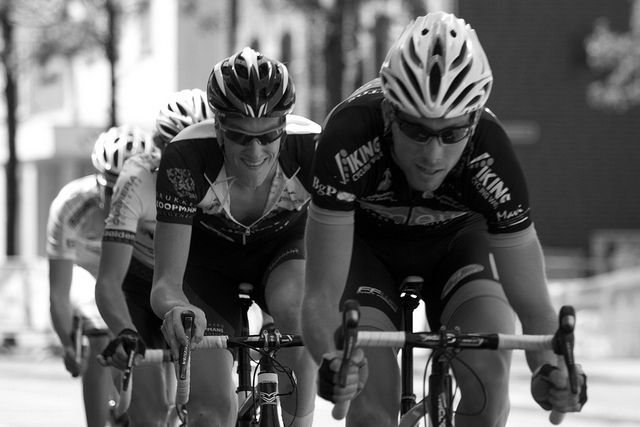
Bicycle racers—even those on different teams—often cooperate to allow the entire group to go faster.
Human cooperation is thought to have evolved because it benefits everyone involved. But we also know that cooperation doesn’t always make sense when subjected to a cost-benefit analysis. For example, people will often do favors for others when there is no expectation of a personal reward—or without even bothering to think about whether there might be a reward.
A recent study published in PNAS presents evidence that humans may engage in these types of uncalculating cooperative activities because it helps their reputation. By cooperating in the moment, people signal to others that they can be trusted to cooperate in the future.
The authors of the paper used a two-stage incentivized economic game to study this phenomenon. The first stage of the game asked participants to decide if they wanted to pay to benefit another player. Players could decide to help without looking at the cost, which was considered to be an uncalculating behavior, or they could check the cost before deciding to assist, which was interpreted as a calculating behavior. This calculating behavior was thought to be analogous to the type of cost-benefit analysis people often do before deciding to be cooperative.
The second stage of the experiment was a trust game in which players exchanged money with each other in phases. participants had to decide how much money to give to their partners without knowing the amount of money that the partner would later return to them, making the transaction risky. But each money exchange was tripled by the experimenter, so the payoff could be large. Still, it required a certain amount of trust that a partner would be generous in response to receiving generosity.
The researchers repeated this two-stage experiment twice. The first time, they looked at “calculating” behavior—whether or not a player looked at the amount of money required to benefit the other player in stage 1. The second time, the researchers examined the length of time it took participants to decide whether or not to help the other player in stage 1. Previous experiments have shown that quick cooperative choices are seen to be more sociable than decisions made after long deliberation.
In both experiments, participants were more likely to engage in uncalculated cooperative behavior if they knew that they were being observed, something that has been seen in other studies. Beyond that, however, the researchers found that participants who engaged in uncalculated cooperation were considered to be more trustworthy by their partners. This assessment turned out to be accurate: uncalculating cooperators actually were more likely to be trustworthy in subsequent trials of the game. So the early cooperation appears to be an honest signal of later behavior.
The authors say these findings support their hypothesis that people use uncalculating behavior to secure reputational benefits—they were signaling to their partners that they were trustworthy and reliable. These actions laid the groundwork for cooperation in the later stages of the game. According to the authors, this study is the first to show that people are more likely to show uncalculating cooperation when they know their reputations are at stake (like when they are being observed).
Even if people don’t make cooperative decisions based on a cost-benefit analysis, the choice to act cooperatively will be beneficial to their reputation and their future interactions. Ironically, even the most unselfish and uncalculated act of cooperation does in fact benefit the person who does it.
PNAS, 2016. DOI: 10.1073/pnas.1601280113 (About DOIs).